Equipment
Aircraft Leasing in India: The Capital Strategy Behind Every Flight
A comprehensive guide to aircraft leasing, GIFT City, lease structures, regulatory reforms, and the economics behind airline fleet expansion.



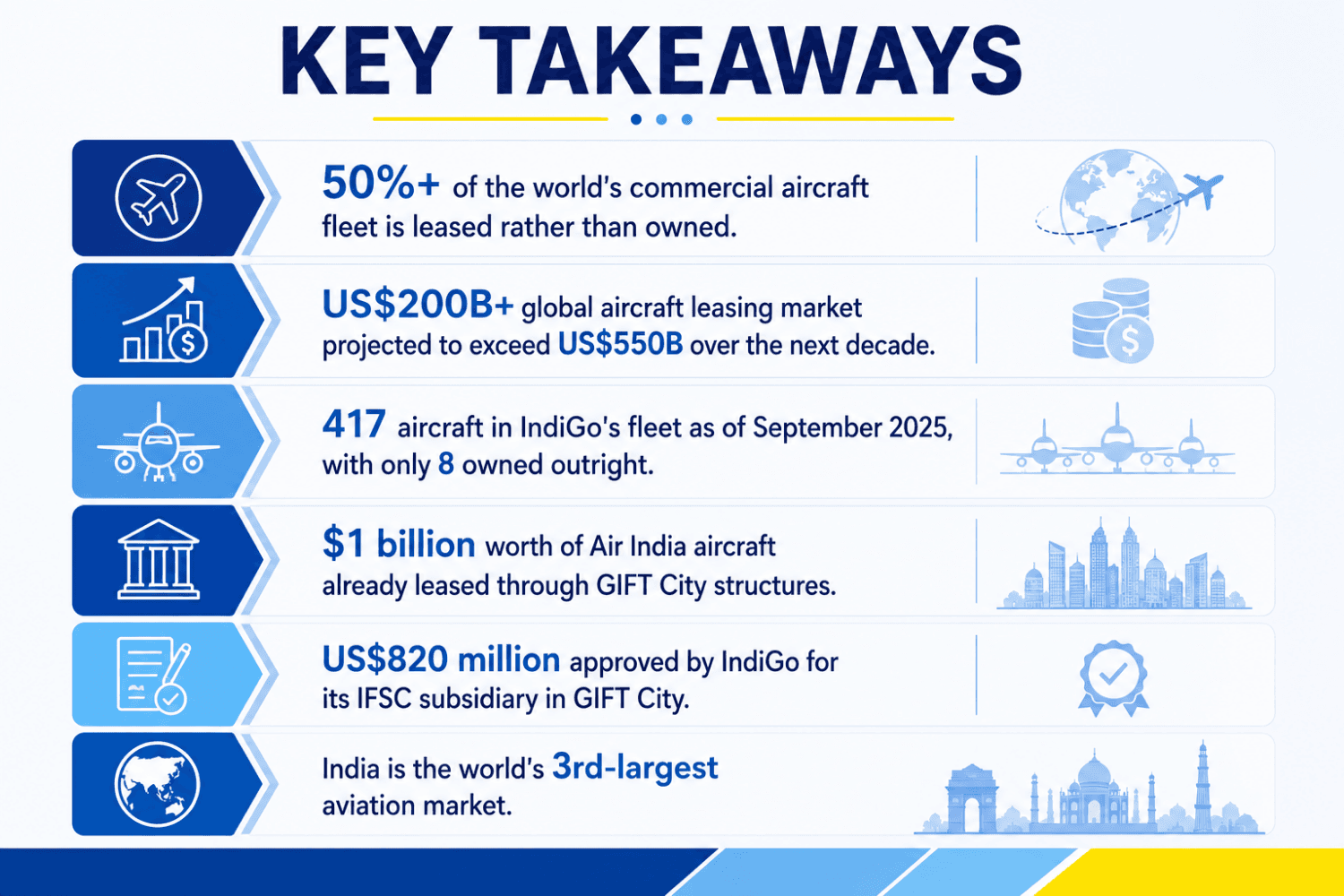
The global aircraft leasing industry is already worth well over$200 billion and is projected to grow to more than $550 billion over the next decade, making it one of aviation's largest asset-financing segments. [1]
Do you know that the aircraft you travel in may not actually be owned by the airline you frequently fly with? In reality, more than half of the world's commercial aircraft fleet now operates under leasing arrangements and has become the dominant financing model for modern airlines.
India has emerged as the world's third-largest aviation market and is expected to remain one of the fastest-growing aviation economies globally, supported by rapid passenger growth, record aircraft orders, and large-scale airport expansion. [2]
So when you board an IndiGo or Air India flight, the aircraft carrying you may belong to a leasing company, based out of, Dublin, Singapore, or soon, Gujarat's GIFT City, and not owned by the airline whose logo is painted on the tail.
For an airline, buying every aircraft with cash would tie up enormous capital. Leasing preserves liquidity, improves fleet agility, and reduces the upfront burden of growth. It also allows airlines to match aircraft type and lease tenor to route strategy.
A narrowbody fleet may be leased differently from a widebody fleet, and a fast-growing airline may prefer sale-and-leaseback structures to keep expansion moving without waiting for a full ownership cycle.
This is especially relevant in India, where growth is rapid, and fleet requirements change quickly. IndiGo’s own disclosures show why leasing remains central.
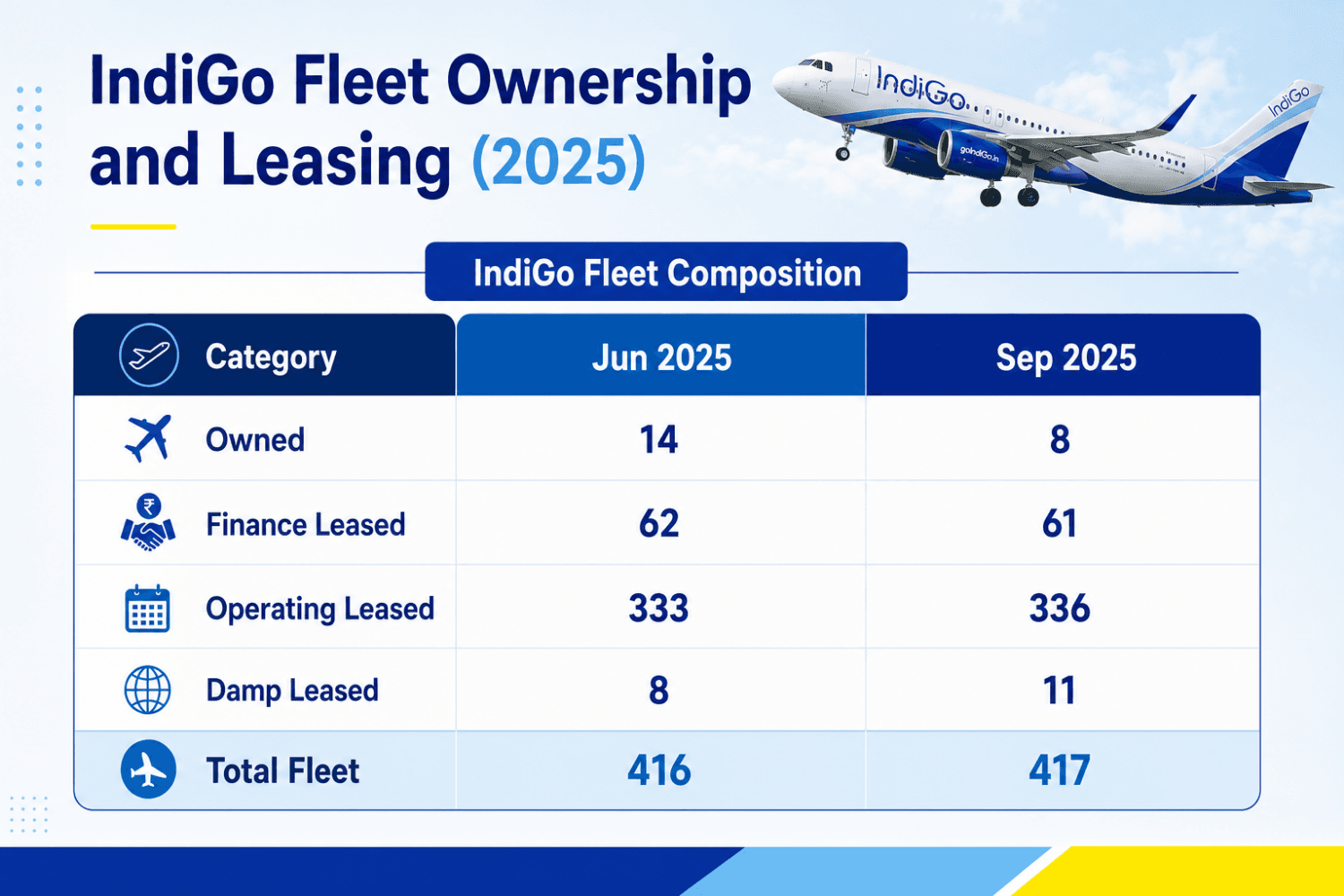
IndiGo also said in July 2025 that it targets a 40% capacity share by 2030, up from around 28% in FY2025, underlining how closely its growth story is tied to fleet financing. [3]
The main lease structures: operating lease, finance lease, and sale-and-leaseback
In aviation, the most common structures are operating lease, finance lease, and sale-and-leaseback. An operating lease is the classic “rent the aircraft for a fixed period” model. A finance lease is closer to a long-term financing arrangement and is often used when the economic substance looks more like asset financing than short-term rental.
Sale-and-leaseback, or SLB, is the structure that turns aircraft delivery into liquidity: the airline sells the aircraft to a lessor and immediately leases it back.
That SLB structure is especially powerful for large airlines that can negotiate strong purchase prices from manufacturers. A simplified example illustrates the economics: an airline secures an aircraft at a bulk discount from the manufacturer, sells it to the lessor at a modest markup, and then pays monthly lease rentals over a 6–12 year term.
It can book an immediate gain while the lessor earns its return through rentals plus residual value at the end of the lease. In other words, the airline monetises the spread today, and the lessor harvests the asset’s future value.
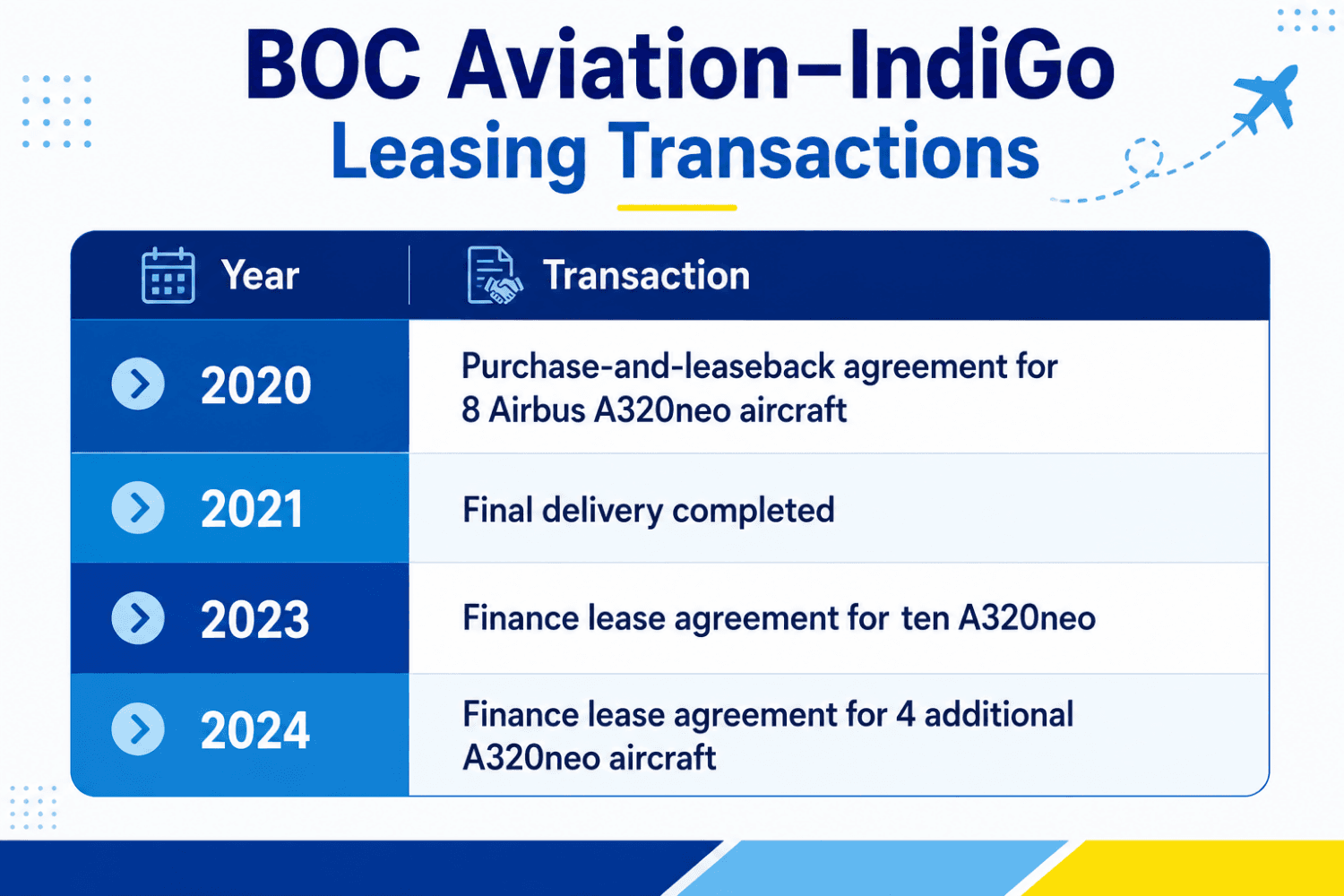
In the case of Indigo (Interglobe Aviation), the following table demonstrates how SLB structures were used for fleet expansion.
Why India Matters in Global Aircraft Leasing
GIFT City is the most important domestic story in Indian aircraft leasing. IFSCA has an official aircraft leasing framework and a consolidated aircraft lease circular updated on 15 November 2023, which was later referenced again in its 2025 bulletin.
The framework explicitly recognises aircraft leasing as a regulated financial activity in the IFSC, and the government’s 2020 notification treated aircraft leases, including operating, finance, and hybrid leases, as financial products.
This matters because a lessor wants more than a good aircraft. It wants regulatory certainty, legal clarity, tax predictability, and efficient access to funding. GIFT City was built for that kind of transaction architecture.
IFSCA’s own material shows the practical direction of travel: Air India has established AI Fleet Services IFSC Ltd in GIFT City, operationalised it in 2023, and used it for leasing activity.
Air India has already leased six wide-body aircraft from GIFT City valued at about US$1 billion. IndiGo has also opened a GIFT City office to strengthen its financing capability, and in November 2025, its board approved a USD 820 million investment in its IFSC subsidiary.
For years, Indian airlines largely relied on offshore lessors. That is changing. IndiGo’s activity is one example. Air India’s GIFT City structure is another.
IFSCA’s aircraft leasing and bulletin show the regulator is actively building the ecosystem, while the Ministry of Civil Aviation’s 2025 bill is intended to strengthen repossession certainty and improve the ease of doing business. [7]
Taken together, these are the ingredients needed for India to retain more aviation finance value onshore instead of exporting it abroad.
How lessors make money
At a high level, a lessor makes money from the spread between its funding cost and the lease rental it receives, plus the residual value of the aircraft when the lease ends.
In practice, lessors raise money through bank debt, syndicated loans, export credit financing, bonds, asset-backed securities, and equity capital. The aircraft itself often serves as collateral, which is why legal protection and repossession speed matter so much.
That is also why lessors care about where the aircraft is registered, which law governs the lease, how defaults are handled, and whether they can export the aircraft quickly if things go wrong. The lessor is not just renting an aircraft. It is underwriting a legal and financial pathway for the asset to retain value across the lease term.
Consider a simplified example. If an airline buys at a discount, sells to a lessor at a slightly higher price, then pays rent over 6 to 12 years, the airline gets immediate liquidity, and the lessor can target a low-double-digit return once rent and residual value are combined. That is why sale-and-leaseback has become such a durable aviation finance tool.
The legal shield for lessors: Cape Town, IDERA, and India’s new rules
The Cape Town Convention is central to aircraft leasing because it creates a framework for international interests in mobile equipment. DGCA’s own site now places IDERA, or Irrevocable De-registration and Export Request Authorisation, directly under its quick links, and the new 2025–26 rules define the Convention and set out a registry process for international interests.
The rules require registration of an international interest within 30 days of registration of the aircraft object in India, or within 90 days for aircraft already operating in India when the rules came into force. They also set out procedures tied to default, export, and the handling of outstanding dues.
The Ministry of Civil Aviation’s 2025 bill goes further in policy intent. It says the reform is meant to improve contract enforceability and repossession certainty for creditors and lessors, boost domestic leasing hubs such as GIFT City, and support more favourable financing and leasing markets for Indian carriers. That is exactly the kind of reform the sector has been waiting for.
Conclusion
Aircraft leasing is one of those businesses that looks invisible until you understand it. Then it becomes obvious why some of the world’s smartest capital prefers it. It sits at the intersection of hard assets, structured finance, regulatory design, and international mobility.
For HNIs and sophisticated investors, it is a useful lens on how global capital finds yield in real assets while managing downside through collateral, legal control, and asset remarketing.
For India, the story is bigger than aviation. The country is trying to convert its fast-growing airline demand into a financial-services opportunity. If aircraft financing migrates toward Indian structures, India does not just gain jobs or office space. It gains fee income, financing expertise, tax efficiency, de-dollarisation and a deeper debt market ecosystem around one of the country’s most important growth sectors.

Get Our Newsletter
You to create a robust alternate asset portfolio.FAQ’s
Aircraft leasing is when an airline uses an aircraft by paying rent to a leasing company rather than buying the aircraft outright.
Among the best-known global lessors are AerCap, SMBC Aviation Capital, Avolon, BOC Aviation, and Air Lease. Their official sites show major operations and headquarters in Dublin, Singapore, and Los Angeles, depending on the company.
It is the combination of asset leasing and capital raising. A lessor funds an aircraft using debt, bonds, securitisation, and equity, then earns through lease rentals and residual value.
Because IFSCA has created an aircraft leasing framework for IFSC entities, and the government is actively aligning Indian law with international leasing norms. Air India and IndiGo have both built GIFT City leasing capability.
It refers to aircraft leasing activity regulated by IFSCA inside IFSCs such as GIFT City. The framework covers operating, finance, and hybrid lease structures.
India’s framework now includes IDERA-linked processes and Cape Town Convention-based rules, and the new legislation is designed to improve repossession certainty and export procedures.
The most useful official references are IFSCA’s aircraft leasing page, DGCA’s IDERA link, and the Ministry of Civil Aviation’s 2025 bill and rules documents.
Related Insights

Income-Generating Collectibles: How Art, IP & Scarce Assets Build Wealth
From Labubu dolls to intellectual property rights, collectibles have become capital.

Operating Lease
With growing industrialization, and diversification across the value chain, fixed asset purchase and financing have become a key area of disruption.
Income-Generating Collectibles: How Art, IP & Scarce Assets Build Wealth
From Labubu dolls to intellectual property rights, collectibles have become capital.
Operating Lease
With growing industrialization, and diversification across the value chain, fixed asset purchase and financing have become a key area of disruption.