Real Estate
Driving Tourism and Delivering High Yields: The Rise of Hotel Apartment Investments in Dubai
Read How Dubai hotel apartments evolved from pre-COVID growth to post-COVID resilience, now offering investors high yields and global credibility.


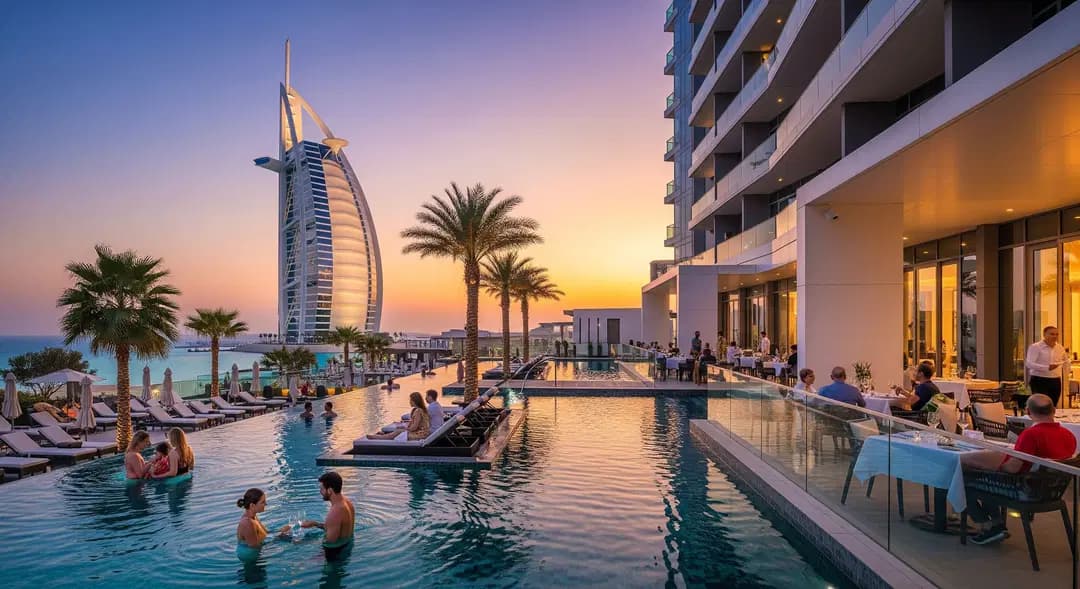
Picture this: You own an apartment that not only appreciates in value but also generates consistent rental income without the hassle of finding tenants, managing maintenance, or dealing with vacancy periods. Welcome to the world of hotel apartments – where real estate meets hospitality, and investors meet extraordinary returns.
In the heart of the Middle East's most dynamic city, a revolution in property investment has been quietly unfolding over the last 2 decades.. While traditional real estate investors grapple with market volatility and tenant management challenges, a growing number of savvy investors have discovered the golden opportunity that lies within Dubai's hotel apartment sector, buoyed by tourism.
The Genesis: When Dubai Opened Its Hospitality Doors to Investors
The concept of selling hotel apartments to private investors isn't entirely new, but Dubai has elevated it to an art form. The emirate's vision began taking shape in the early 2000s, when the government recognized that tourism would be a cornerstone of its economic diversification strategy.
The theory behind selling hotel units to individual investors was revolutionary yet simple: democratize hospitality investment. Instead of requiring investors to spend millions to develop an entire hotel, Dubai introduced a model that allowed developers to forward sell the units and finance the development, and for the investors to purchase individual units within branded hotel properties. The regulatory support and visionary leadership of the country led to a market where;
Hotels could raise development capital more efficiently and expeditiously without relying on local debt
Individual investors could enter the hospitality real estate market with lower capital requirements.
Professional hotel operators would get a large portfolio of properties within a short time, ensuring consistent service standards while managing costs efficiently, and
Rental guarantees for investors/ buyers of the hotel units and apartments, while high, were still significantly lower than foreign debt with hedging costs, in a seemingly volatile market like Dubai.
Pre-COVID: The Foundation Years (2015-2019)
Before the pandemic reshaped global travel, Dubai's hotel apartment market was steadily establishing itself as a viable investment alternative. The period from 2015 to 2019 was characterized by[3] :
Market Growth
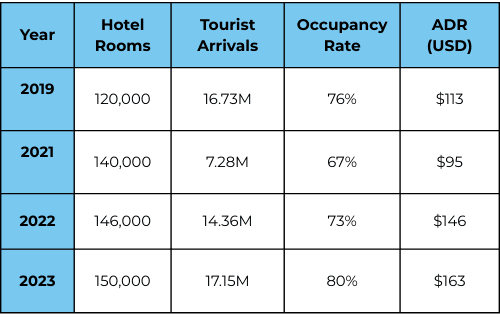
Hotel room inventory reached approximately 120,000 rooms by 2019[3]
Average occupancy rates hovered around 76-78%[3]
Tourist arrivals peaked at 16.73 million in 2019[4]
Investment Characteristics
Average rental yields: 5-8% annually[3]
Property appreciation: 3-5% per year
Investment tickets: Starting from AED 1.5 million for studio apartments/hotel units
Popular Locations
The pre-COVID era saw concentration in key areas:
Post-COVID Phoenix: The Remarkable Recovery Story
If there was ever a testament to Dubai's resilience and vision, it was the hospitality sector's post-COVID recovery. While cities worldwide struggled with travel restrictions and economic uncertainty, Dubai charted a different course. By the end of 2021, some Dubai hotels were already reaching almost full occupancy, signifying the sector's return to normal and Dubai’s demand as a tourist destination.[2]
Notwithstanding the slowdown during the COVID years, the UAE now hosts one of the richest hospitality markets in the world, with an expected 25% growth in the industry by 2030 and 40 million new visitors staying at hotels in Dubai by 2031.[3]
The Recovery Statistics
Dubai's hospitality sector hit $29.4bn in 2022 amid Covid rebound, and the numbers tell a remarkable story.[4]
2022 Performance Indicators[4]:
Occupancy Rates: Reached 73% (one of the world's highest), up from 67% in 2021
Room Nights: 37.43 million – up 19% year-over-year and 17% above 2019 levels
Average Daily Rate (ADR): US$146, representing a 29% increase from 2019
Revenue per Available Room (RevPAR): US$106, up 25% from pre-pandemic levels
2023 Breakthrough[4]:
In 2023, the city welcomed 17.15 million overnight visitors, surpassing its previous high of 16.73 million in 2019
Early 2023 occupancy rates averaged 80%
ADR climbed to US $163
RevPAR reached US $130, 16% above 2019 levels
How Hotel Apartment Investment Works: The Dubai Model
The Dubai hotel apartment investment model operates on a sophisticated yet investor-friendly framework.
Ownership Structure
When you purchase a hotel apartment in Dubai, you own the title deed to the property, just like any other freehold real estate investment. However, the property operates within a hotel environment, managed by the developer's own hospitality arm (e. ROVE is by Emaar, while Paramount Hotel is run by Damac Properties) or professional hospitality companies (eg, SLS Hotel is run by the Accor Group).
Rental Guarantees
While the payout to investor/ unit owners vary in terms of timing and value, there are basically two broad categories.
Fixed Rental - this is a simpler but lesser used model, where the developer sells, and then leases back the hotel units, for a fixed rental, generally paid quarterly or annually; OR
Revenue Share- where the gross earnings of the hotel are reduced by operating expenses, and the balance is shared with the unit holders basis the unit type, carpet areas, and revenue per unit type, through a pre-agreed formula which is then audited by an auditor, post which payouts are made to the owners, mostly once a year.
There are sun set clauses in most deals, where the rental guarantee could be for a tenure of 5 or 10 years, and thereafter the payouts are only linked to revenue share.
Usage and User Rights
Most Hotel Unit investments come with few additional perks for the investors, like free nights, with or without blackout dates. Generally ranges between 14- 21 days a year, where the investors have free nights to use in their own units or similar units in the hotel. Additional benefits of discounted rates for stay/ services, owner rates across hotels owned/ operated by the same owner/ operator etc, can also form part of the investment. It's therefore very important to understand the investment ROI in detail, and is not standard for all hotel units being offered, in primary or in secondary sale.
The unit holder does not generally get a say in operations or the right to choose/ replace operators. As such, the developer controls the property's future outcomes, even after selling out the property to retail investors.
Hotel units and apartments can be sold in the open market, however, all owners have to accept the terms of usage as determined by the developer/ operator, as the units are not freely controlled by the investor-owner.
Hotel Apartments vs. Traditional Properties: The Investment Advantage
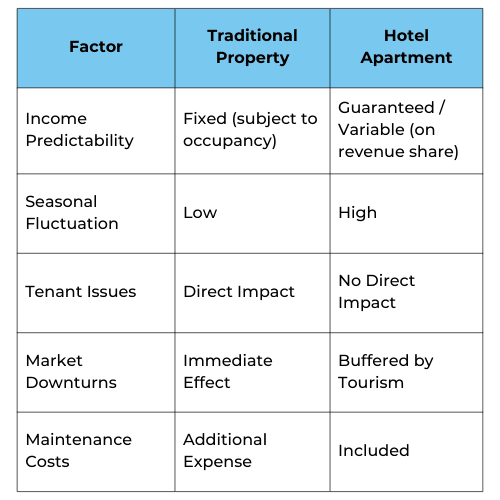
The question every investor asks: "Why choose hotel apartments over traditional residential properties?" The answer lies in the fundamental differences in investment dynamics:
Rental Yield Comparison
Traditional Dubai Residential Properties:
Rental Yields: 3-6% annually[1]
Tenant Management: Required to be done by owner or at additional cost
Maintenance: Owner's responsibility
Vacancy Risk: High during market downturns
Property Management: Owner handles or pays separately
Dubai Hotel Apartments[2]:
Rental Yields: 6-15% annually (from revenue share)
Tenant Management: Hotel operator handles
Maintenance: Included in management fee
Vacancy Risk: Distributed across hotel operations
Property Management: Professional hospitality management
Income Stability Matrix
Consistent High-Yield Returns with Passive Ownership in Hotels
Investing in Dubai hotel units typically delivers superior, more predictable returns. Many developments guarantee roughly 8–10% annual ROI due to strong tourist demand.[2] Hotels in prime districts typically enjoy high occupancy and steady bookings. Newer locations, like those that are close to high traffic tourist destinations (eg. Yas Islands in Abu Dhabi, or developing Al Marjan island in Ras Al Khaima) are being built with a promise of localised high density tourist demand, in an attempt to replicate the Dubai model, with adjacency to Dubai. Crucially, operators handle all bookings and maintenance, so owners truly benefit from a fully hands-off model, with a guaranteed high quality asset management.[2]
Residential Apartments: Moderate Yields but higher Capital Appreciation and Liquidity
New Dubai apartment projects have shown only modest growth in yield, since Covid-19 but very high capital appreciation. Older projects in high demand areas like Downtown or Jumeirah Beach and even Dubai Marina, have shown significant capital appreciation, as well as re-rating of rental yields, which is not likely to repeat again in the near future.[1]
Older projects like Azizi Riviera studios roughly doubled in price (~99.9% total, ~9.1% YoY) over 7–8 years, and off‑plan purchases in new projects like Binghatti Skyrise saw ~70% appreciation since its launch.[1]
Some residential projects however have shown a varying returns profile than the norm. For example, Bays by Danube recorded only ~10% total Capital Appreciation since launch (~1.2% YoY), however the annualised rental yield delivered was nearly ~11.35%.[1]
In summary, Dubai hotel investments deliver higher, steadier returns with far less hassle, and lower investment thresholds, but have lower capital price appreciation, and lower liquidity than residential investments; and therefore, the asset class attracts different investors as compared to residential off-plan investments.
The High-Yield Reality: Understanding Hotel Apartment Returns
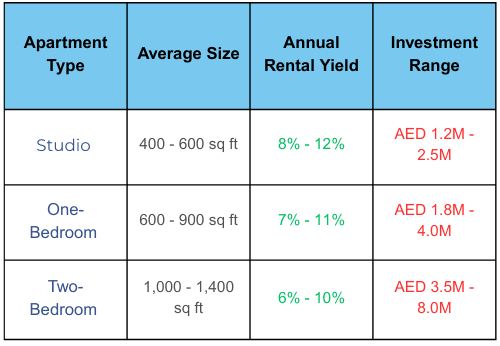
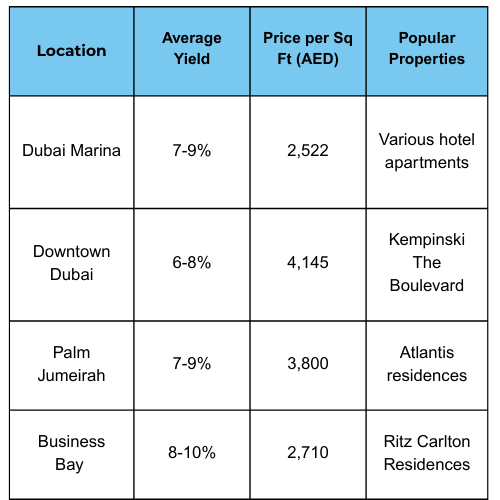
Location-Based Yield Analysis:[1]
Based on market data from the past 12 months:
Dubai vs. Global Hotel Investment Markets
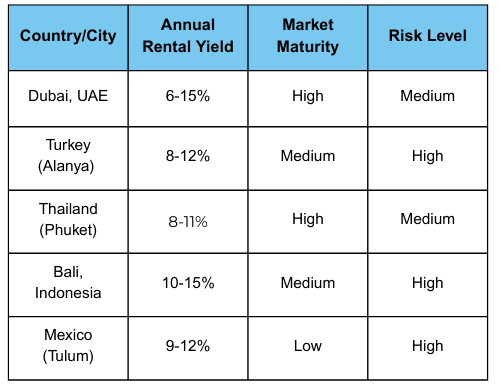
Dubai's competitive advantage lies in:
Political Stability: Established governance and investor protection
Infrastructure: World-class airports, connectivity, and facilities
Tourism Diversity: Business, leisure, and transit tourism
Regulatory Framework: Clear property laws and ownership rights
Currency Stability: AED pegged to USD provides significant stability
Tokenisation and Crypto Friendliness - Dubai properties, including hotel properties can be transacted with Cryptos (subject to rules)
Future Projections: The Road Ahead (2025-2030)
The future of Dubai's (and a few other UAE locations) hotel apartment market looks remarkably bright for the medium term.[5]
Supply Pipeline[5]:
11,300 new hotel rooms expected by 2027
Dubai Economic Agenda D33: Aims to make Dubai a top-3 global tourism destination
Expo Legacy: Continued infrastructure and tourism benefits
Demand Drivers[3]:
40 million visitors projected by 2031
25% industry growth expected by 2030
Regional Hub Status: Growing importance as Middle East business center
Investment Climate (2024-2025)[5]:
Occupancy: Currently at 78.1% (December 2024)
Average Daily Rate: ~AED 690 (slight increase from 2023)
RevPAR Growth: 1.3% year-over-year
Why Choose AFINUE for Your International Property led Investments, especially in UAE
We understand that investing in international markets, whether immigration linked property investment or for asset risk diversification, requires more than just property or market knowledge. Such investment decisions demand local expertise built over time, regulatory understanding, monetisation and liquidity support and overall a pulse of the regional and global economy, to not just choose the right investment but also factor in exit options and liquidation preferences right upfront. Here's why discerning investors choose us:
Our Expertise:
Market Intelligence: Deep understanding of Dubai's real estate market and future potential.
Verified Properties: Pre-screened investments with transparent yield projections, directly sourced from Developers.
Legal Compliance: Complete assistance with UAE property regulations and procedures, handholding through the transaction life cycle and beyond.
Portfolio Diversification: Advice is not limited to project, but actually pin pointed to which units, which floors, and what views/ orientation.
Post-Purchase Support: Ongoing property intelligence, support in monetisation/ liquidity event selection, with on ground local partnerships
More Than Real Estate: Owning a Share of Dubai’s Tourism Boom
Dubai's (and few other UAE locations) hotel apartment market represents more than just an investment opportunity – it's a chance to participate in one of the world's most dynamic hospitality markets. With rental yields significantly outperforming traditional real estate, high quality constructions and professional management and a city that has proven its resilience and growth trajectory as a global tourism destination, the case for hotel apartment investment has never been stronger.[2]
The numbers speak for themselves; from record-breaking sales like the AED 200 million One Za'abeel penthouse[7], to consistent 6-15% rental yields across the market[2], Dubai continues to attract investors who understand the value of combining high yield real estate investments with hospitality-led developments.
As we move forward through 2025 and beyond, with 11,300 new hotel rooms coming online by 2027 and Dubai's ambition to become a top-3 global tourism destination, the thesis to invest in this sector remains compelling.[5]
Whether you're a seasoned real estate investor looking to diversify your portfolio or a newcomer attracted by the high yields and professional management, Dubai's hotel apartment market offers a unique proposition that deserves serious consideration.
Bibliography:
[1] Bayut Sales Data - Dubai Hotel Properties Research (2025)
[2] The First Group - "Why Dubai is the World's Hottest Hotel Investment Market" (2023) -https://www.thefirstgroup.com/en/news/why-dubai-is-the-world-s-hottest-hotel-investment-market/
[3] MMC Investment - "UAE Hospitality Industry Performance and Outlook 2015-2029" - https://www.mmcginvest.com/post/uae-hospitality-industry-performance-and-outlook-2015-2029
[4] Cavendish Maxwell - "Dubai's Hospitality Sector Market Performance in 2023" - https://cavendishmaxwell.com/insights/reports-and-whitepapers/dubais-hospitality-sector-market-performance-in-2023
[5] KPMG - "Dubai Hospitality Report 2025" - https://assets.kpmg.com/content/dam/kpmg/ae/pdf-2025/04/dubai-hospitality-report.pdf
[6] NevEstate - "Best Resort Real Estate Investments 2025: Top 5 Countries" (5 months ago) - https://nevestate.com/uncategorized-en/best-resort-real-estate-investments-2025-top-5-countries/
[7] Hotel Report - "Record Breaking Sale: Dubai's Most Expensive Hotel Apartment Sells for 200 Million Dirhams" - https://hotel.report/management/record-breaking-sale-dubais-most-expensive-hotel-apartment-sells-for-200-million-dirhams
[8] Excel Properties UAE - Downtown Dubai Property Prices: Trends, Growth and ROI Potential - https://excelproperties.ae/blog/downtown-dubai-property-prices-trends-growth-and-roi-potential


Get Our Newsletter
You to create a robust alternate asset portfolio.Related Insights

Golden Visas for Indians: Global Residency & Citizenship by Investment Guide
Explore Golden Visa and citizenship-by-investment programs available to Indians. Learn how global residency, investment migration, and mobility portfolios help diversify wealth, access global markets, and secure long-term opportunities.

REITs, InVITs, and Real Estate Tokenization: Transforming Property Investments
Explore how REITs, InVITs, and real estate tokenization are transforming property investments. Learn how these financial instruments provide liquidity, diversification, and access to high-value real estate for investors, making property investment easier.

Goa’s Real Estate Evolution: From Holiday Haven to Investment Powerhouse
What turned Goa from a tourist spot into India's fastest-growing property market? Read the blog to know how India's coastal paradise transformed into an investment hotspot.

From Retreat to Returns: The Rise of Holiday Rentals in India
Holiday homes in India have evolved from family getaways to lucrative investment assets. Discover how shifting preferences, remote work, Airbnb, and fractional ownership are reshaping the holiday home to holiday rental market and how AFINUE is helping investors be a part of it.
From Free Reign to Regulations
Explore how Dubai’s shift from crypto freedom to regulation is reshaping real estate and how AFINUE mirrors this, with fractional ownership in India.
Golden Visas for Indians: Global Residency & Citizenship by Investment Guide
Explore Golden Visa and citizenship-by-investment programs available to Indians. Learn how global residency, investment migration, and mobility portfolios help diversify wealth, access global markets, and secure long-term opportunities.
REITs, InVITs, and Real Estate Tokenization: Transforming Property Investments
Explore how REITs, InVITs, and real estate tokenization are transforming property investments. Learn how these financial instruments provide liquidity, diversification, and access to high-value real estate for investors, making property investment easier.
Goa’s Real Estate Evolution: From Holiday Haven to Investment Powerhouse
What turned Goa from a tourist spot into India's fastest-growing property market? Read the blog to know how India's coastal paradise transformed into an investment hotspot.
From Retreat to Returns: The Rise of Holiday Rentals in India
Holiday homes in India have evolved from family getaways to lucrative investment assets. Discover how shifting preferences, remote work, Airbnb, and fractional ownership are reshaping the holiday home to holiday rental market and how AFINUE is helping investors be a part of it.
From Free Reign to Regulations
Explore how Dubai’s shift from crypto freedom to regulation is reshaping real estate and how AFINUE mirrors this, with fractional ownership in India.