Real Estate
Golden Visas for Indians: Global Residency & Citizenship by Investment Guide
Explore Golden Visa and citizenship-by-investment programs available to Indians. Learn how global residency, investment migration, and mobility portfolios help diversify wealth, access global markets, and secure long-term opportunities.



A decade ago, a second passport meant migration. Today, it means leverage. More than ~35 million Indians diaspora are now one of the largest sources of global migrants and high-net-worth emigration.[1]
According to global migration reports in 2023, over ~6,500 high-net-worth (HNI) Indians relocated abroad. The number continues to rise in 2026 as global capital, education, and business become borderless.[2]
But here’s what changed.
This is no longer about leaving India. It is about building options. Indian founders, professionals, and wealth creators are not chasing passports. They are building mobility portfolios. And that is where the Golden Visa enters the picture.
What Is a Golden Visa?
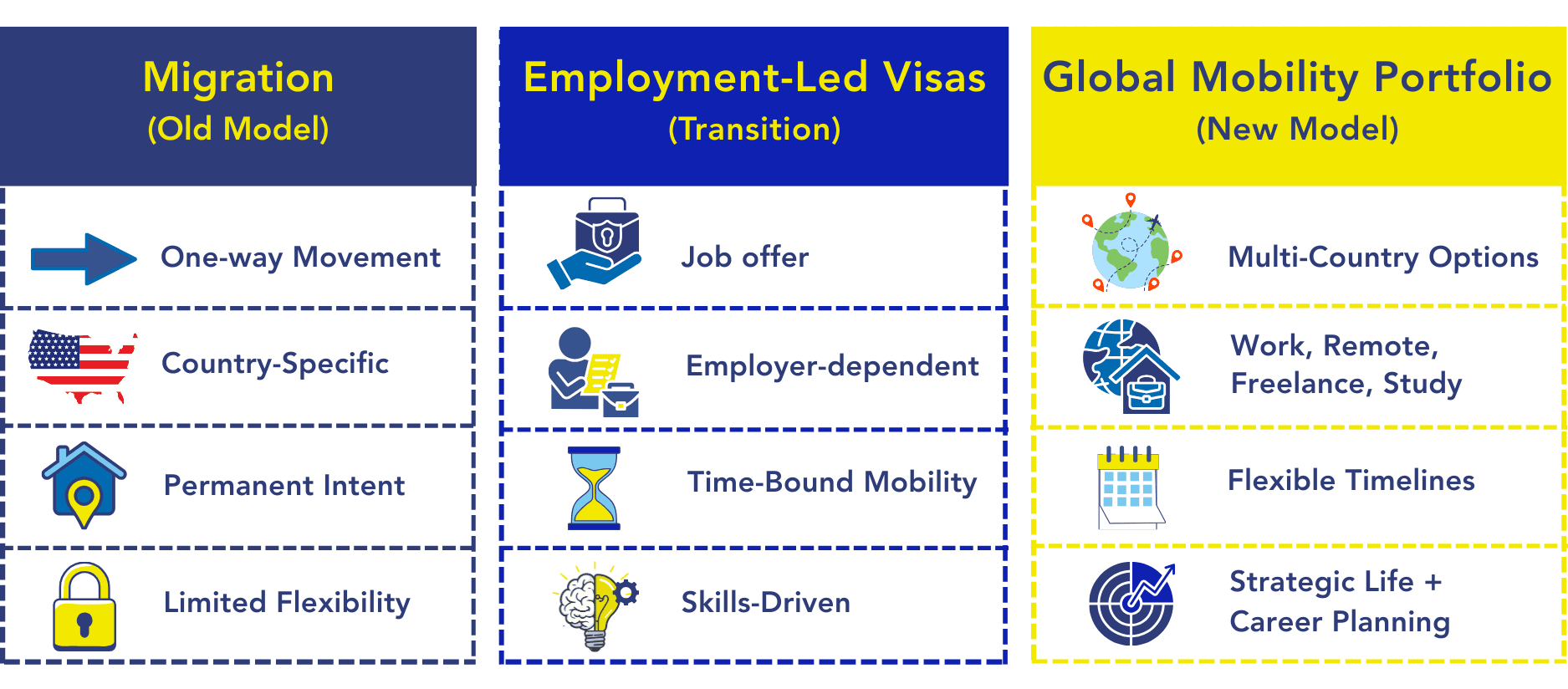
A Golden Visa is a government-approved residency-by-investment program. It allows foreign nationals to obtain long-term residency in a country in exchange for a qualifying financial investment, typically in real estate, investment funds, business capital/ventures, or government bonds.
Unlike traditional immigration routes that depend on employment sponsorship, ancestry, or family reunification, a Golden Visa is primarily capital-based.
This blog explores how Golden Visas and Citizenship-by-Investment (CBI) programs work, the countries that offer them to Indians, and why these pathways are becoming integral for wealth diversification, protection and succession planning.
Let's first start with capital-based migration, where an investment grants citizenship.
Citizenship by Investment
CBI programs offer a direct route to acquiring citizenship in exchange for a significant economic contribution, typically through a government fund donation, real estate purchase, or business investment. These are typically government-backed, legally codified programs designed to attract foreign capital to a particular country.
For Indians, Caribbean, and select emerging-market CBI programs, are among the most accessible and efficient.
Key Caribbean Citizenship-by-Investment Options.
The Caribbean remains the epicentre of structured CBI programs, accounting for a significant share of global investor-led naturalisation applications. These five jurisdictions operate government-backed frameworks with established due diligence systems, defined investment thresholds, and relatively predictable processing timelines.
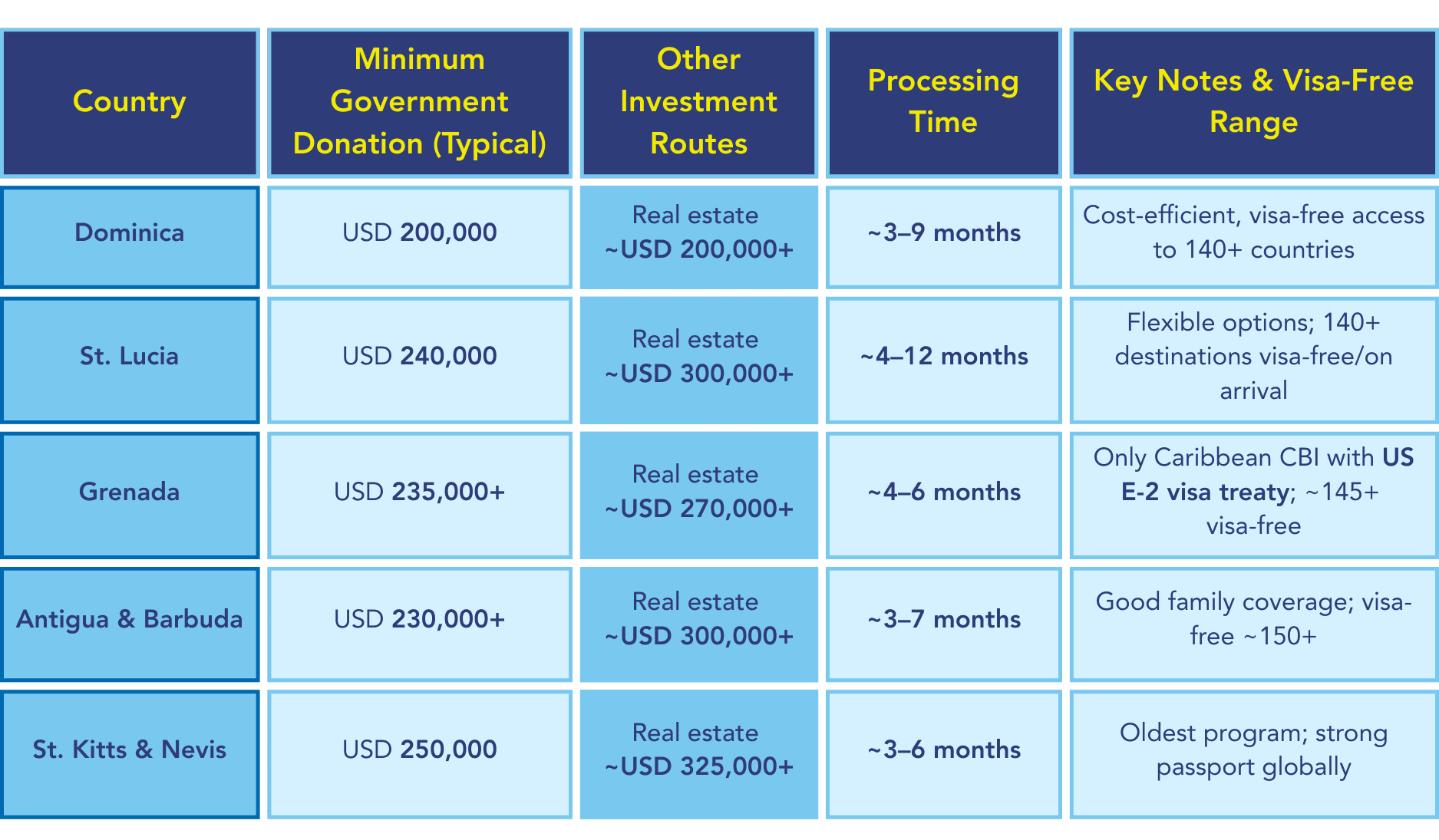
In 2024, the Eastern Caribbean CBI nations aligned minimum donation thresholds and strengthened due diligence protocols under international regulatory scrutiny. This harmonisation enhanced program integrity but also increased entry costs and documentation requirements.
Beyond the Caribbean
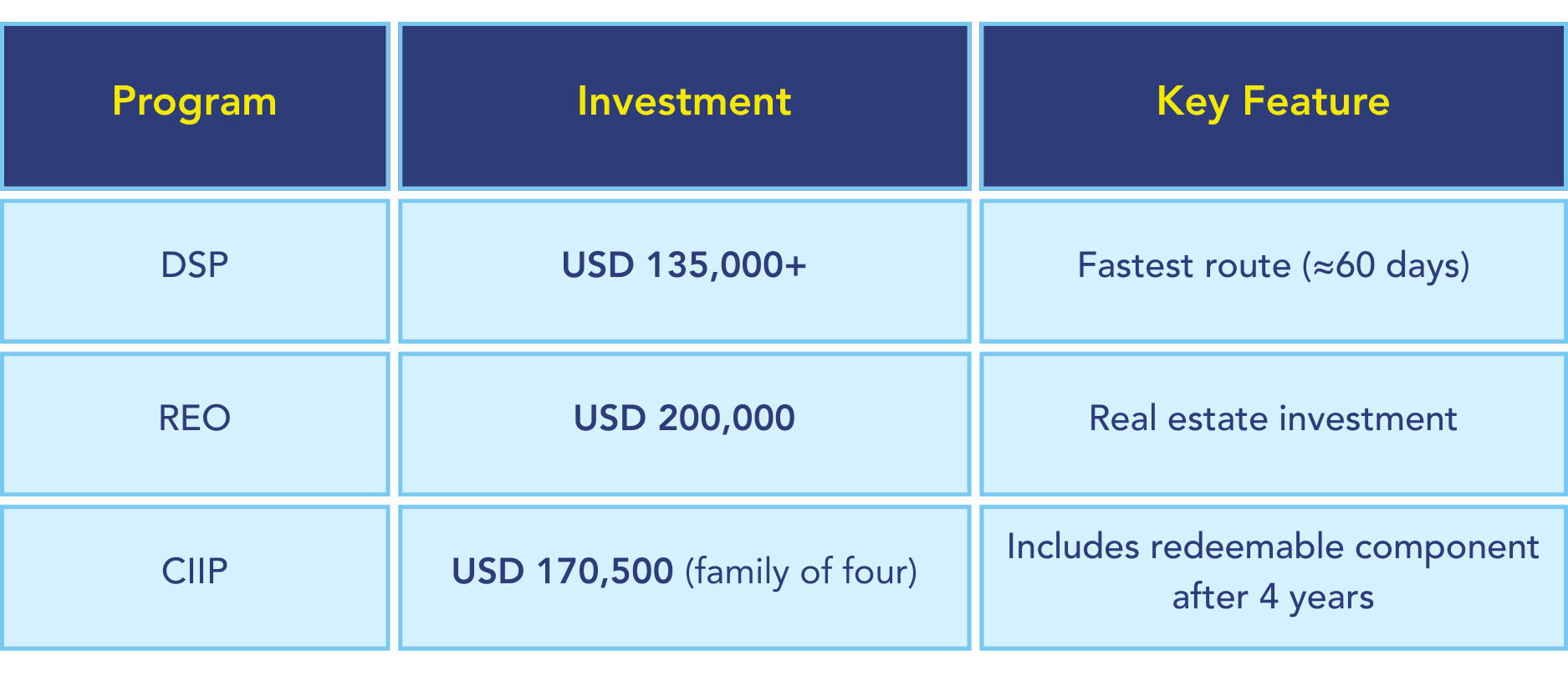
Vanuatu is known for its Development Support Program (DSP), one of the fastest citizenship programs in the world, often completed in around 60 days, making it appealing to applicants prioritising speed.
Vanuatu currently offers multiple opportunities under its citizenship-by-investment program, including:
DSP - Development Support Program: A government donation route and the fastest pathway to citizenship.
REO - Real Estate Option: Citizenship obtained through a qualifying real estate investment.
CIIP - Capital Investment Immigration Plan: An investment-based route involving government-approved funds with a redeemable component after several years.
Pacific programs are often favoured for speed and lower entry thresholds. However, applicants should carefully evaluate the long-term geopolitical stability of these programs and the durability of the visa-free travel privileges associated with such passports, and international banking perception before proceeding. Some Pacific passports have faced increased scrutiny in recent years, underscoring the importance of long-term strategic positioning over short-term processing speed.
Vanuatu currently offers three citizenship-by-investment routes, DSP, REO, and CIIP, each with different investment structures.
Turkey
Offers citizenship via a USD 400,000 real estate investment (with a mandatory three-year holding period) or qualifying business investment. The program is asset-backed and popular among investors seeking tangible property exposure alongside passport acquisition.[3]
Egypt
Provides multiple routes, including government contribution, real estate acquisition, and business investment. The framework has evolved in recent years, making regulatory confirmation essential before application.
Jordan
Operates an investment-linked residency and citizenship program, typically tied to enterprise creation or strategic capital contribution. Approvals are discretionary and aligned with national economic priorities.
North Macedonia & Moldova
Emerging European opportunities offer donation-based or public fund investment routes. These programs are not European Union citizenship routes and should be evaluated within their regional mobility context.
These programs typically attract globally mobile individuals seeking a second passport to enhance travel freedom, diversify geopolitical exposure, and expand international business opportunities. While Indian citizens cannot hold dual citizenship, in some cases, adult children may obtain a second nationality through such programs, while parents retain Indian citizenship and maintain ties through Overseas Citizen of India (OCI) status
Among Indian migrants, long-term settlement remains the most sought-after route, with continued favour towards the United States, Australia, Canada, and the United Kingdom, with other European destinations also drawing increasing numbers of skilled workers and students.
Major Immigration Economies
Unlike European residency-by-investment programmes, major economies operate structured investor or business-led immigration systems rather than passive “Golden Visas.” These pathways typically require active capital deployment, job creation, innovation, or skills contribution.
United States
The United States operates the Employment-Based Fifth Preference (EB-5) Immigrant Investor Program, a structured investment-based immigration route rather than a traditional Golden Visa. The programme requires a minimum investment of USD 800,000 for Targeted Employment Area (TEA) or USD 1,050,000 (non-TEA) and the creation of at least 10 full-time (each requiring a minimum of 35 hours per week) for qualified U.S. jobs. Successful applicants receive conditional permanent residency (Green Card), which may lead to permanent residence and eventual U.S. citizenship, subject to residency and legal requirements. The US model is impact-driven and employment-linked rather than passive real estate acquisition.
In 2025, former U.S. President Donald Trump announced a proposed investor visa initiative informally referred to as the “Trump Gold Card.” The proposal suggested offering fast-tracked U.S. residency to wealthy foreign investors who could contribute at least USD 1 million and demonstrate a substantial economic benefit to the United States.
However, the programme has not yet been formalised within U.S. immigration law, and no official visa category currently exists under this framework. As of now, the primary investment-linked immigration pathway in the United States remains the EB-5 Immigrant Investor Program, which requires capital investment and the creation of at least 10 full-time jobs for U.S. workers.[4]
United Kingdom
The UK no longer operates a traditional investor visa. The Tier 1 Investor route was closed in 2022. High-net-worth individuals now enter via the Innovator Founder Visa, which generally requires £50,000 in investment funds for a scalable business (subject to endorsement), or through the Global Talent Visa, which does not prescribe a fixed investment threshold but requires recognised exceptional expertise. The framework prioritises innovation and economic contribution over passive capital investment. Citizenship is possible after sustained lawful residence, typically following Indefinite Leave to Remain (ILR) obtained after 3–5 years, depending on the visa route, with naturalisation generally available after holding ILR for at least 12 months. [4][6]
Canada
Canada permanently closed the Quebec Immigrant Investor Program (QIIP). Current investor-oriented pathways include the Start-Up Visa Program, requiring backing from a designated venture capital fund (minimum contribution of CAD 200,000), angel investor group (CAD 75,000), or business incubator acceptance. Provincial Nominee Programs may require varying capital commitments depending on the province and business model. Permanent residency is the primary objective, with citizenship eligibility after meeting residency thresholds.[7]
Australia
Australia significantly wound down its Business Innovation and Investment Program (BIIP) between 2023 and 2024, including the Significant Investor Visa (SIV). While new applications under traditional investor streams have largely ceased, remaining business innovation pathways require substantial capital investment and active business participation. Australia now prioritises skilled migration and economic impact over passive capital deployment, and has no defined migration program linked to capital investments.[8]
Distinction Between Golden Visa (Temporary or Permanent Residency) vs Immigrant Visa/ Citizenship and WHY it Matters.
Golden Visa jurisdictions typically allow residency through defined capital thresholds, often linked to real estate or funds.
Investor immigration economies like the US, UK, Australia, and Canada instead emphasise:
Job creation
Innovation and business activity
Skills-based contribution
Economic impact
For Indian investors, the distinction is strategic: European and Gulf Golden Visas offer mobility optionality and asset diversification, while developed economies prioritise long-term settlement tied to economic integration.
India does not permit dual citizenship. Acquiring foreign citizenship requires formal renunciation of Indian nationality, followed by an application for Overseas Citizen of India (OCI) status if continued long-term access to India is desired. This regulatory step materially affects decision-making and should be carefully evaluated when choosing Citizenship by Investment options.
Golden Visas: Residency First, Citizenship Later
Unlike CBI programs, Golden Visas are residency-by-investment. They grant long-term residence in exchange for investment, with the possibility, though not a guarantee, of citizenship after several years.
A Golden Visa typically allows the holder to live, work, or study in the host country without being a traditional immigrant or employee. Most programs allow family inclusion, making them particularly attractive for long-term planning.
For many Indians, Golden Visas strike a balance: they provide access to a country’s economic and social infrastructure without requiring immediate relinquishment of ties to India.
Also Read: Golden Visa through Real Estate
Explore Top Golden Visa Programs for Indians (2026)
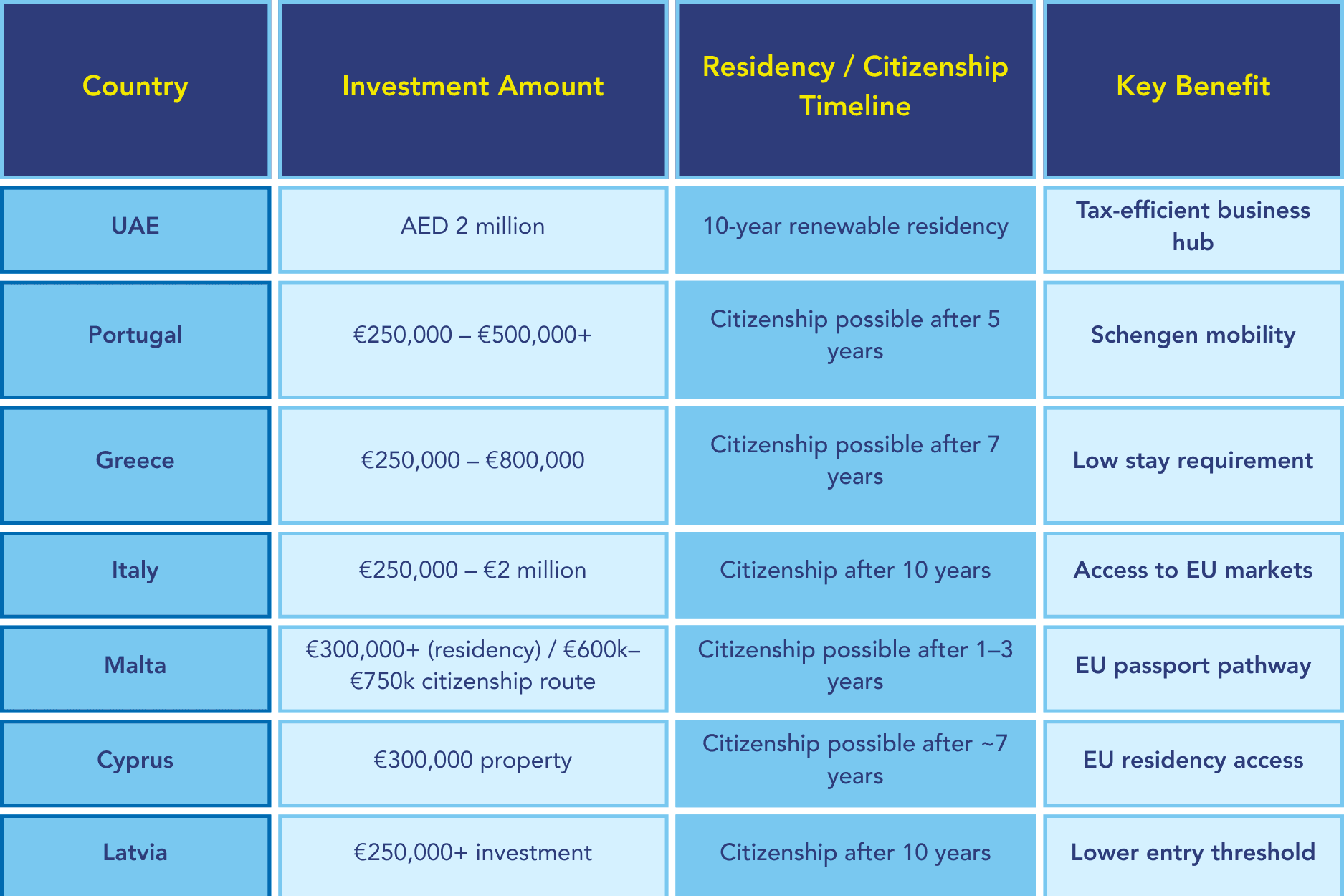
United Arab Emirates (UAE)
The UAE Golden Visa is one of the most widely adopted programs by Indians.
10-year renewable residency
No local sponsor required
Family sponsorship allowed
Typical investment: AED 2 million (real estate or business)
While the UAE does not offer citizenship through this route, its tax efficiency, business ecosystem, and proximity to India make it highly attractive.
Indians are among the largest beneficiaries of the UAE Golden Visa program, securing long-term residency across investor, entrepreneur, and skilled categories. With a ~3.5 million-strong Indian expatriate community in the UAE, business and cultural ties remain deeply integrated. Real estate, especially in Dubai and Abu Dhabi, continues to be the most popular route for Indian applicants.
For Indian HNIs and entrepreneurs, the UAE offers portfolio diversification, global banking access, estate planning flexibility, and a politically stable, tax-efficient environment. For many, the Golden Visa is less about migration and more about mobility, tax optimisation, and strategic asset positioning.[9]
Portugal
Portugal has seen steady interest from Indian investors, particularly post-Brexit, as UK access changed. While Chinese and Brazilian applicants historically dominated the program, Indian participation has gradually increased, particularly through private equity fund routes rather than real estate, following recent policy shifts.
The Indian community in Portugal is growing, with over 1,03 lakh Indian residents, including professionals, entrepreneurs, and tech workers. Lisbon and Porto have emerged as startup hubs attracting Indian founders and remote entrepreneurs.[10]
Portugal remains Europe’s most recognised Golden Visa program, and for Indian investors, Portugal offers:
Investment routes through funds, business creation, and cultural contributions
Citizenship eligibility after 5 years
Schengen mobility across 29 countries
Investment range: €250,000 – €500,000+
Since its launch in 2012, the Portugal Golden Visa has issued over ~12,700 main residence permits, attracting global investors with flexible routes and access to the Schengen area. In 2023, around 199 Indian investors secured Golden Visas, reflecting continued interest from the Indian HNI segment. [11] [12]
Greece
Greece offers one of Europe’s most accessible residency options.
Real estate investment range from €250,000 to €800,000 (location-dependent)
Minimal physical stay requirements
Full family inclusion
Citizenship is possible after 7 years (subject to conditions).
Greece offers tangible portfolio opportunities for Indian investors. The country’s property market has seen steady recovery and urban regeneration, particularly in Athens and select island destinations, attracting Indian buyers seeking Euro-denominated real estate exposure. Rental yields driven by tourism and short-term leasing platforms provide income potential, while EU residency enhances long-term asset liquidity and cross-border flexibility. For Indian HNIs, Greece is less about immediate migration and more about strategic European positioning, combining Schengen mobility, property diversification, and optional future citizenship within a stable EU framework.
Italy
Italy’s Investor Visa provides multiple entry points:
€250,000 – Innovative startups
€500,000 – Italian companies
€1 million – Philanthropic donation
€2 million – Government bonds
Citizenship Requirements:
10 years of legal residence
Clean criminal record
Proof of sufficient income
Italian language proficiency (B1 level)
The country’s advanced manufacturing base, luxury goods sector, renewable energy initiatives, increasing popularity of its luxury tourism and growing startup ecosystem offer direct business investment opportunities and expansion potential. Milan, Rome, and emerging innovation hubs provide access to EU markets, institutional banking networks, and cross-border corporate structuring advantages.
Rather than serving as a short-term mobility hedge, Italy appeals to Indian founders and family offices seeking operational presence in Europe, combining capital deployment, brand expansion, and long-term citizenship optionality in a G7 (Group of Seven) economy that consists of Canada, France, Germany, Italy, Japan, the United Kingdom, and the United States. However, taxation is a concern when compared to other options.
Other Notable Residency Programs
Latvia
Latvia offers residency through multiple investment routes:
€250,000+ – Real estate investment OR 50,000+ to €100,000 – Business investment (plus capital contribution)
€250,000– Subordinated bank investment/government securities.
Future Citizenship Requirements:
10 years of legal residence, Continued Permanent residency status, Latvian language proficiency, Knowledge of the Constitution and history, and a Clean criminal record.
Latvia’s residency-by-investment programme is rebounding, but it remains very small compared to other Golden Visa schemes. In H1 2025, 44 main applicants were approved, already 76% of 2024’s total, with 107 permits issued, including dependents, putting the country on track for its highest Visa issuance in this category over the last four years.
For Indian investors, Latvia is a strategic Northern European foothold rather than a lifestyle migration destination. Positioned within the Baltic region, Latvia offers proximity to Scandinavian and Nordic markets, making it relevant for entrepreneurs exploring logistics, IT services, global fintech, and trade expansion into Northern Europe. The country’s growing tech ecosystem and digital infrastructure have also attracted interest from globally mobile founders. From a portfolio perspective, Latvia’s relatively lower capital threshold allows diversification into Euro-denominated assets while maintaining access to EU banking and regulatory frameworks. For Indian HNIs seeking cost-efficient European optionality with business expansion potential, Latvia functions as a pragmatic mobility and market-entry strategy rather than a relocation-driven decision.[13]
Malta
Malta stands out for offering both residency and citizenship-by-investment pathways.
€300,000+ – Real estate (purchase)
€600,000+ – Citizenship contribution (36-month residency route)
€750,000+ – Fast-track citizenship (12-month residency route)
Additional mandatory donations and due diligence fees apply
Citizenship Requirements:
Minimum 12–36 months of residency (depending on investment level)
Strict multi-tier due diligence
Clean criminal record
Proof of genuine links to Malta
Malta hosts a small but growing Indian community, estimated at around 18,000 Indians as of recent data, including both residents and long-term workers. Malta issued 33,455 foreign work permits in 2025, and with Indians consistently among the largest non-EU beneficiary groups, reflecting increased economic participation.
From an opportunity standpoint, Malta’s English-speaking environment, robust financial and gaming sectors, and proximity to major European markets make it attractive for Indian entrepreneurs and professionals. The country’s bilateral trade with India, modest but growing, supports commercial engagement and cross-border business potential. Indian investors often view Malta not just as a residency destination but as a gateway into EU markets, with clear and transparent business setup options, and a way to diversify assets across European regulatory and banking systems.
This sustained presence suggests steady Indian interest in Malta’s residency pathways, including the Malta Permanent Residence Programme (MPRP).[14][15]
Cyprus
While Cyprus no longer operates a direct citizenship-by-investment (“golden passport”) programme, which was terminated in 2020 after regulatory scrutiny, the island’s permanent residency-by-investment programme remains active and widely recognised among globally mobile Indian investors. Cyprus promotes foreign real estate investment as a growth driver. The application and approval process is known for efficiency. Physical residence requirements are minimal.
€300,000 – Residential property purchase (permanent residency route)
Citizenship Requirements:
Long-term legal residence (typically 7+ years under naturalisation)
No criminal record
Proof of stable income
Basic knowledge of Greek
Cyprus hosts a small but steadily growing Indian community, with estimates of around 15,000 Indians residing on the island as of recent counts, working across sectors such as ICT, shipping, fintech, tourism and professional services. These communities are often concentrated in urban centres like Nicosia, Limassol and Paphos, where cultural networks, Indian festivals, and expat groups are increasingly active.
Estonia
Estonia offers residency primarily through business and startup pathways. There are specifically 3 clear options.
A - Invest in an existing business that creates jobs and economic impact for the Country, also known as the Major Investor Scheme
B - Set up a new business as a foreign entrepreneur, which could be an expansion of your existing business from any other country, which helps create new jobs and economic impact. This is also known as the Immigrant Entrepreneur Visa, OR
C - Start-up Visa, which is essentially a new business idea that you set up from scratch in Estonia.
To qualify for the Major Investor Scheme, individuals must invest at least €1,000,000 in an Estonian company, and in return, receive a temporary residence permit, which can be up to a maximum of 5 years, with extension possibilities.
Additionally, for an investor visa (under immigrant entrepreneur or Start up visa, investing non-repatriable, a minimum of €16,000 for a sole proprietorship or a minimum of €65,000 for other ownership structures is also mandatory. Alternatively, a sales revenue of €200,000 per year or monthly social security contributions equivalent to five times the average annual gross salary in Estonia can replace the initial investment requirements for a residence permit under the specific schemes.
What you get in return is as follows:
Right to freely enter the EU and Estonia, and the right to travel freely between other Schengen countries;
The possibility of establishing a personal bank account in Estonia, which enables you to invest in capital markets in Estonia and even in other Schengen countries
If you are basing your existing business or starting up, you get to make your business a resident entity with Estonian tax residency, which gives a general corporate tax rate of 22% on distributed profits, but NO TAX if profits are re-invested; and
The unique opportunity to benefit from 32 Bilateral Investment Treaties, plus 62 Double Tax Avoidance Treaties;
Citizenship Requirements:
8 years of legal residence (5 years permanent residence), Estonian language proficiency, Clean criminal record, Renunciation of previous citizenship (dual citizenship is restricted)
Estonia offers residency primarily through business and startup pathways, making it particularly attractive to globally mobile Indian founders and tech entrepreneurs. Estonia is less about lifestyle migration and more about digital and tax leverage, while being able to access the EU region. The country is globally recognised for its advanced digital governance, streamlined company incorporation process, and strong startup ecosystem. For Indian entrepreneurs, this creates multiple strategic advantages besides personal opportunities for better health care and European education for dependents.
Panama
Panama provides flexible residency routes for investors and global citizens.
$200,000+ in Real estate investments. Friendly Nations Visa, Business or employment-based route, 1(The Friendly Nations Visa grants residency to eligible nationals who establish economic ties in Panama, either by forming a company or obtaining local employment.)
Reforestation and other investment options are also available as a means of obtaining residency through direct investments. [16]
Citizenship Requirements:
5 years of residency
Basic Spanish proficiency
Economic ties to Panama
Physical presence requirements (flexible but mandatory)
While citizenship requires multiple years of legal residence and Spanish proficiency, most Indian applicants view Panama through the lens of mobility and portfolio strategy, using residency as a gateway to the Americas, establishing tax-efficient structures, and gaining flexible access across continents. In this context, Panama complements other Golden Visa and residency programs by offering commercial optionality, tax diversification, and proximity to major Western Hemisphere markets, making it a compelling component of an Indian investor’s / Business Families global mobility and portfolio planning toolkit. [17]
Costa Rica
Costa Rica offers residency through investment and income-based programs.
$150,000+ – Investment residency
$2,500/month – Pensionado (retirement program)
$2,500/month – Fixed income residency
Citizenship Requirements:
7 years of legal residence
Basic Spanish proficiency
Clean criminal record
Demonstrated integration into Costa Rican society
For Indian investors evaluating global mobility options, Costa Rica presents strategic lifestyle and portfolio advantages. Its geographic location in Central America offers convenient access to both North and South American markets, making it attractive for business owners managing multinational operations or seeking a regional foothold. The country’s emphasis on environmental sustainability and quality of life, ranked among the world’s happiest nations in several global surveys, also resonates with Indian families considering long-term relocation or retirement planning. Costa Rica functions as a strategic lifestyle and investment pivot point, particularly for Indian citizens exploring multi-jurisdictional residency, tax diversification, and hemispheric business expansion, while balancing ageing and retirement constraints.
Countries that operate residency-by-investment programs without using the term “Golden Visa.”
Singapore’s Global Investor Programme (GIP) offers permanent residency to investors and business owners committing SGD 2.5 million or more. Citizenship is possible but highly discretionary.
New Zealand’s Active Investor Plus visa targets ultra-high-net-worth individuals, with investments starting from NZD 10 million and a structured residency pathway.
Malaysia’s MM2H (My Second Home) program offers long-term renewable residency through fixed deposits, though it does not lead to citizenship.
Switzerland allows residency for wealthy individuals through 14%–35% at the canton-level tax or investment agreements, with citizenship possible after 10–12 years, depending on residency and integration.
Which Golden Visas Can Lead to Citizenship?
Not all Golden Visas lead to citizenship.
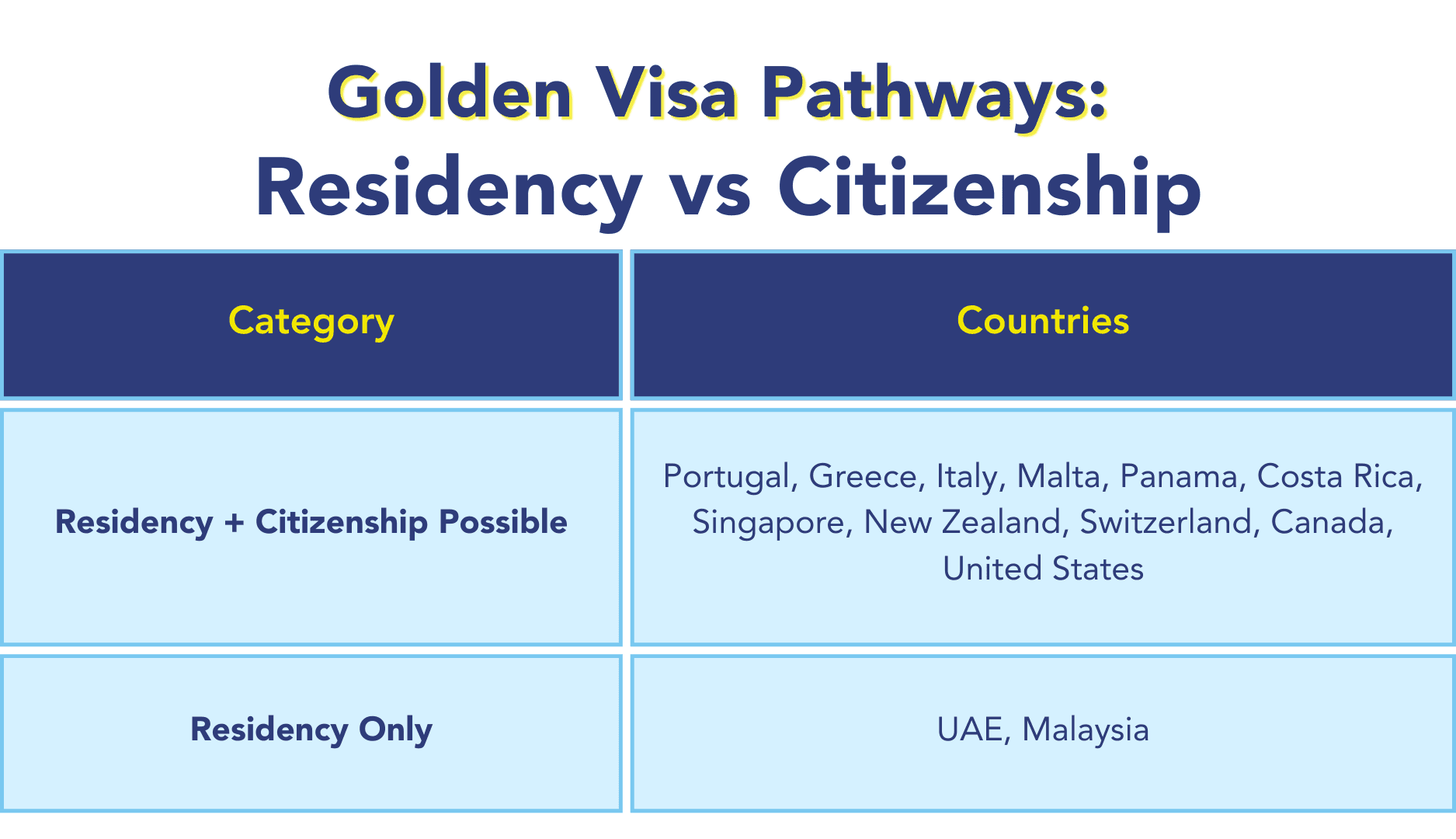
Understanding this distinction is critical. For some investors, tax efficiency and mobility are the priority. For others, long-term political security, policy stability and generational planning matter more.
Why Global Mobility Matters to Indians
The global Indian diaspora is deeply entrenched across major economies. The United States hosts over ~5.4 million people of Indian origin, Canada nearly ~2.9 million, the United Kingdom ~1.86 million, and the UAE around ~3.57 million, according to India’s Ministry of External Affairs (2025). Malaysia and Saudi Arabia also host multi-million-strong Indian communities. Global integration is no longer aspirational; it is structural.
Golden Visa and Citizenship-by-Investment programs build upon this established international footprint. They are not merely migration mechanisms; they are instruments of strategic positioning. For Indian investors and globally mobile families, these programs offer:
• Visa-free or easier travel
• Education and healthcare access
• Business expansion opportunities
• Currency and asset diversification
• Long-term family wealth protection
For many Indian families, these programs are about expanding strategic options in a multipolar world. Global mobility now functions as a form of portfolio insurance, a way to hedge geopolitical, economic, and regulatory risk while maintaining strong ties to India’s growth story.
Conclusion
Golden Visas and Citizenship-by-Investment programs reflect a broader shift in how wealth is defined and preserved. In an uncertain world, mobility, choice, and jurisdictional diversification have become as valuable as financial returns.
For Indians with global aspirations, these programs offer structured, legal pathways to expand opportunity, whether through a New Passport, strategic residency, or long-term access to key global markets.
Global mobility is now, more than ever, a capital allocation decision. For Indian investors and families building diversified business and asset portfolios across jurisdictions, residency and citizenship pathways are one layer of a broader wealth strategy.
Connect us at Afinue, we focus on opportunities that offer structured fractional ownership and alternative investment opportunities that allow investors to access global assets, international private markets, and cross-border growth, along with optionality for Golden Visas or even citizenship.
Explore how smart allocation across geographies and asset classes can strengthen both mobility and long-term wealth resilience.

Get Our Newsletter
You to create a robust alternate asset portfolio.FAQ’s
Golden Visas provide long-term residency, global mobility, access to international education and healthcare, business expansion opportunities, and diversification of assets across countries.
Popular European Golden Visa destinations for Indians include Portugal, Greece, Italy, Malta, Cyprus, and Latvia, offering residency through real estate, investment funds, or business investments.
Among the more affordable programs are Latvia (€50,000+ business route), Greece (€250,000+ real estate), Cyprus (€300,000 property), and Portugal (€250,000+ investment routes).
Common Golden Visa countries include the UAE, Portugal, Greece, Italy, Malta, Cyprus, Latvia, Panama, Costa Rica, Malaysia, Singapore, and New Zealand.
Some programs offer a pathway to citizenship after meeting residency requirements. For example, Portugal (~5 years), Greece (~7 years), and Italy (~10 years) allow citizenship after long-term legal residence.
Related Insights

REITs, InVITs, and Real Estate Tokenization: Transforming Property Investments
Explore how REITs, InVITs, and real estate tokenization are transforming property investments. Learn how these financial instruments provide liquidity, diversification, and access to high-value real estate for investors, making property investment easier.

Goa’s Real Estate Evolution: From Holiday Haven to Investment Powerhouse
What turned Goa from a tourist spot into India's fastest-growing property market? Read the blog to know how India's coastal paradise transformed into an investment hotspot.

Driving Tourism and Delivering High Yields: The Rise of Hotel Apartment Investments in Dubai
Read How Dubai hotel apartments evolved from pre-COVID growth to post-COVID resilience, now offering investors high yields and global credibility.

From Retreat to Returns: The Rise of Holiday Rentals in India
Holiday homes in India have evolved from family getaways to lucrative investment assets. Discover how shifting preferences, remote work, Airbnb, and fractional ownership are reshaping the holiday home to holiday rental market and how AFINUE is helping investors be a part of it.

From Free Reign to Regulations
Explore how Dubai’s shift from crypto freedom to regulation is reshaping real estate and how AFINUE mirrors this, with fractional ownership in India.
REITs, InVITs, and Real Estate Tokenization: Transforming Property Investments
Explore how REITs, InVITs, and real estate tokenization are transforming property investments. Learn how these financial instruments provide liquidity, diversification, and access to high-value real estate for investors, making property investment easier.
Goa’s Real Estate Evolution: From Holiday Haven to Investment Powerhouse
What turned Goa from a tourist spot into India's fastest-growing property market? Read the blog to know how India's coastal paradise transformed into an investment hotspot.
Driving Tourism and Delivering High Yields: The Rise of Hotel Apartment Investments in Dubai
Read How Dubai hotel apartments evolved from pre-COVID growth to post-COVID resilience, now offering investors high yields and global credibility.
From Retreat to Returns: The Rise of Holiday Rentals in India
Holiday homes in India have evolved from family getaways to lucrative investment assets. Discover how shifting preferences, remote work, Airbnb, and fractional ownership are reshaping the holiday home to holiday rental market and how AFINUE is helping investors be a part of it.
From Free Reign to Regulations
Explore how Dubai’s shift from crypto freedom to regulation is reshaping real estate and how AFINUE mirrors this, with fractional ownership in India.