Real Estate
REITs vs InvITs: Which One Belongs in Your Portfolio?
A comprehensive guide to REITs and InvITs in India, covering how they work, generate income, taxation, risks, and long-term investment potential.


India's growth story isn't just being written in boardrooms and policy documents.
It's being built.
In the gleaming office parks of Hyderabad, Noida, Bengaluru, Gurugram and Mumbai, to Malls across Tier-2 cities and even with logistics hubs outside Mumbai and Delhi. Along with the highways connecting industrial corridors and through the power transmission lines energising cities &factories and the telecom towers supporting a digital-first economy.
For investors, this raises an interesting question:
If India's real assets are creating wealth, what's the smartest way to participate?
Traditionally, owning commercial real estate or infrastructure assets required deep pockets, operational expertise, and patience. Today, REITs and InvITs have changed that equation.
As of June 2026, India's REIT market stood at approximately ₹3.10 lakh crore, while the InvIT market had crossed Rs. ₹7.1 lakh crore [1], [2] .
Together, these two asset classes represent more than ₹10 lakh crore worth of listed real assets available to investors.
While both provide regular income and exposure to physical assets, the way they generate returns is very different.
Understanding REITs
A Real Estate Investment Trust (REIT) is a pooled investment vehicle that owns and operates income-generating real estate assets.
These typically include:
Grade-A office parks
IT campuses
Shopping malls
Mixed-use developments
Instead of purchasing physical property directly, investors buy listed REIT units through stock exchanges, similar to equities.
The trust earns income primarily through:
Lease rentals
Asset appreciation
Property management income
Escalating contractual rentals
Under SEBI regulations, Indian REITs are mandated to distribute at least 90% of distributable cash flows to unitholders, making them attractive for income-focused investors.
The structure effectively transforms illiquid commercial real estate into a liquid, yield-generating financial instrument.
India currently has 6 listed REITs:
Embassy Office Parks REIT (Embassy)
Mindspace Business Parks REIT (MINDSPACE)
Brookfield India Real Estate Trust (BIRET))
Nexus Select Trust (NXST)
Knowledge Realty Trust (KRT)
Bagmane Prime Office REIT
At their core, REITs are a bet on India’s commercial urbanisation story.
Understanding InvITs
Infrastructure Investment Trusts (InvITs) are structured similarly but differ radically in asset composition and economic behaviour.
Instead of office buildings or malls, InvITs own infrastructure assets such as:
Highways and Toll Roads
Power transmission lines
Renewable energy assets
Gas Pipelines
Telecom towers
Fibre networks
Logistics infrastructure- warehouses
Logistics parks
Revenue is generated through:
Toll collections
Government annuities
Transmission tariffs
Long-term concession agreements
Usage-based fees
Infrastructure operating contracts
Like REITs, InvITs must distribute at least 90% of distributable cash flows to investors.
However, unlike commercial real estate, most infrastructure assets operate under regulated or concession-based revenue frameworks that are more volatile.
India now has 28 registered InvITs, including:
IndiGrid Infrastructure Trust
IRB Infrastructure Trust
POWERGRID Infrastructure Investment Trust
National Highways Infra Trust
Cube Highways Trust
TVS Infrastructure Trust
InvITs essentially allow investors to monetise India’s infrastructure growth without directly participating in project execution risk.
Why REITs and InvITs Matter in India’s Financial Evolution
Historically, Indian investors seeking real assets faced significant barriers:
High ticket sizes
Illiquidity
Legal complexities
Tenant management issues
Project execution risks
Lack of diversification
REITs and InvITs democratise institutional-grade assets.
Much later than the Western world, retail and HNI investors in India can access rental yield assets, which are financialised and therefore bring significant liquidity.
It represents the increasing financialisation of India’s real economy.
As India expands into a $7–10 trillion economy over the coming decades, the need to recycle capital into infrastructure and commercial assets will intensify. REITs and InvITs provide the capital-market bridge that enables this transition.
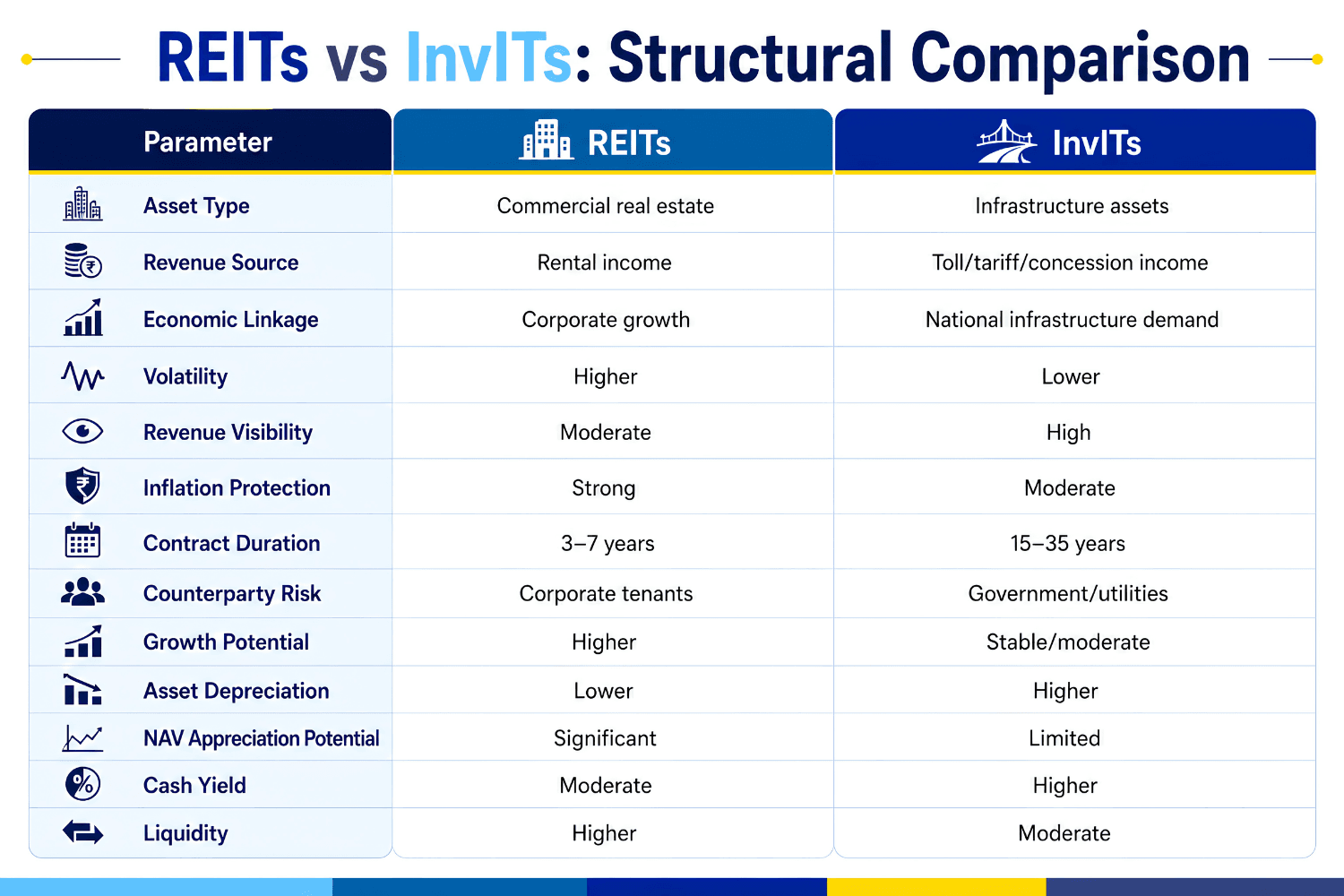
The key distinction lies in how cash flows behave.
REIT cash flows are cyclical and growth-sensitive.
InvIT cash flows are utility-like and concession-driven.
This single distinction shapes almost every return characteristic between the two asset classes.
The Economics of REITs
REITs derive value from three major drivers:
1. Occupancy Levels
Higher occupancy translates directly into rental stability and higher distributions.
In India’s office and Retail REIT ecosystem, occupancy is closely linked to:
IT sector hiring
GCC expansion
BFSI growth
Startup funding cycles
Corporate capex
The post-pandemic return-to-office trend significantly strengthened leasing activity across Grade-A office assets.
2. Rental Escalations
Most commercial leases include:
Fixed annual escalation clauses
CPI-linked increases
Periodic mark-to-market resets
This creates built-in inflation protection.
As rents rise, distributable cash flows improve organically without requiring significant incremental capex.
3. Asset Revaluation
Commercial real estate values appreciate when:
Rentals rise
Vacancy compresses
Cap rates decline
Demand for Grade-A space increases
This creates NAV expansion.
Unlike infrastructure assets, office parks can witness meaningful long-term capital appreciation.
This is why REITs often generate stronger total returns over long periods.
The Economics of InvITs
InvITs behave differently because infrastructure assets are fundamentally utility assets.
Their strength lies in predictability.
1. Long-Duration Contracts
Infrastructure concessions often extend 15–35 years.
This creates extraordinary revenue visibility.
Examples include:
Power transmission agreements
Toll-road concessions
Government annuity contracts
Telecom tenancy agreements
2. Regulated Cash Flows
Many InvIT assets operate under regulatory frameworks that define returns and tariffs.
This significantly impacts volatility- while pricing is not volatile, usage can vary, and hence overall returns oscillate from time to time
Unlike office leasing, revenues are not dependent on corporate occupancy cycles.
3. Essential-Asset as underlying nature
Electricity transmission, highways, fibre infrastructure, and energy assets remain economically essential regardless of business cycles.
As a result, InvITs typically demonstrate:
Lower earnings volatility
Higher distribution predictability
Defensive characteristics
This makes them attractive to income-focused investors.
Historical Performance Comparison
Mindspace REIT (2021-2025)
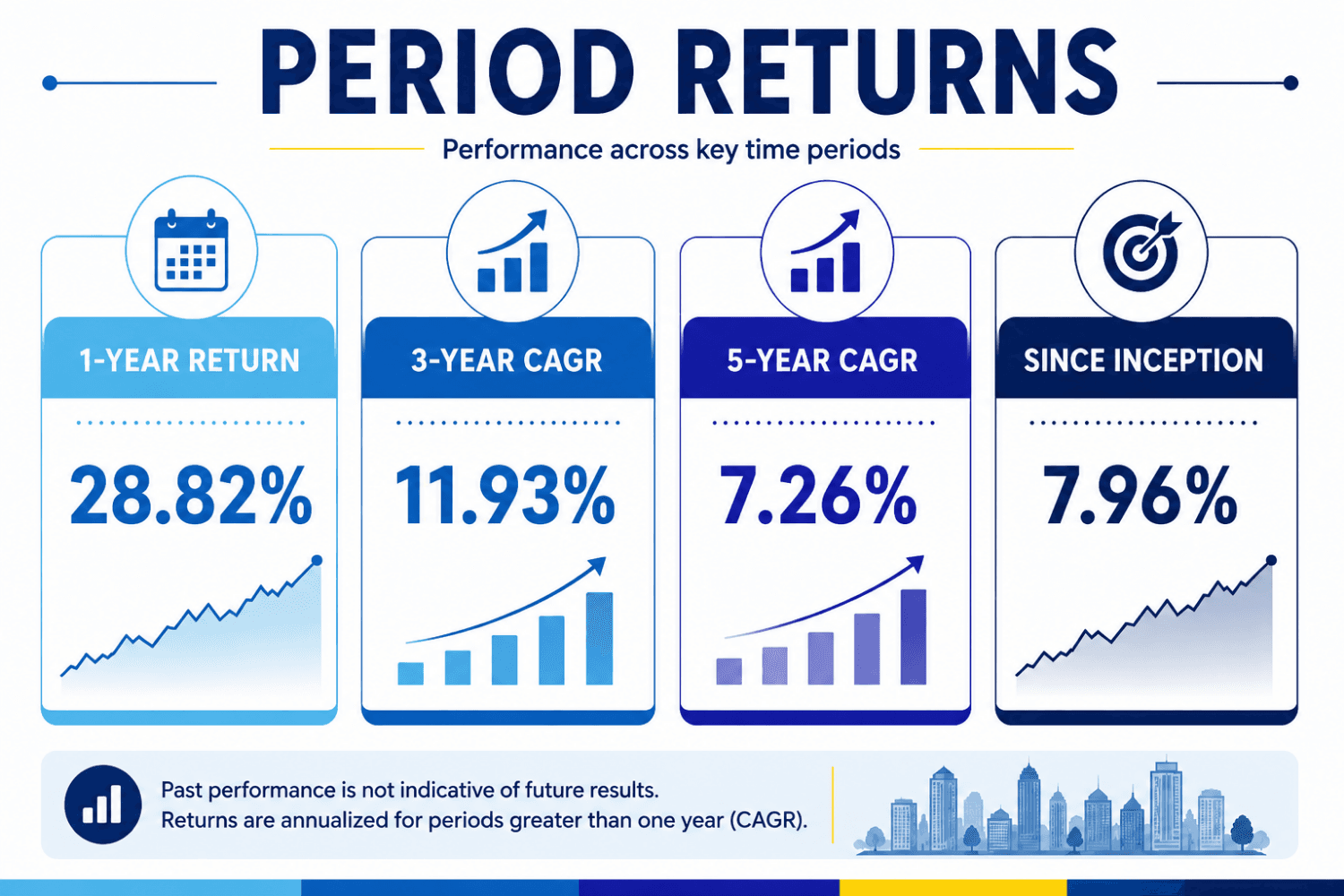
Mindspace has benefited from:
Premium office exposure
GCC demand
Strong leasing activity
Rental escalations
IndiGrid InvIT
Current price – 28 July 2026 - 178
Closing price on 14 January 2025 – 144.37
Closing price on 13 January 2023 – 140.77
Closing price on 14 January 2021 – 122.83
Closing price on inception day – 95.77 [5]
Dividend yield – 12.3
Current Price: ₹179.49 (28 July 2026)
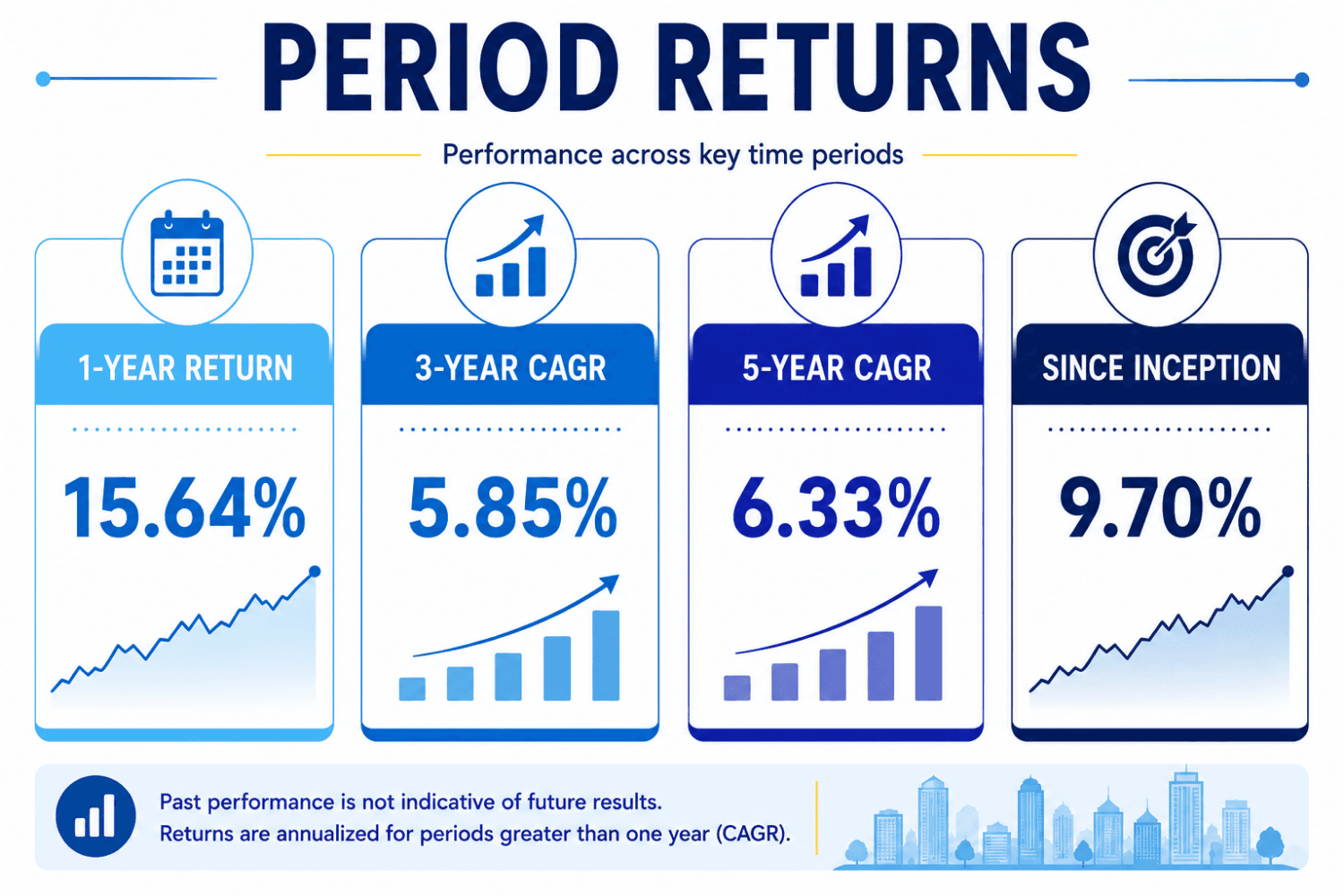
IndiGrid has delivered:
Stable cash yields
Lower volatility
Consistent distributions
However, price appreciation has remained relatively moderate.[6]
Taxation of REITs and InvITs
Both REITs and InvITs are pass-through structures under Indian tax regulations.
Their taxation is nuanced and requires careful interpretation.
Interest Income
Interest distributions are taxed at the investor’s applicable slab rate under “Income from Other Sources.”
Resident TDS: 10%
Non-resident TDS: 5%
Dividend Income
Dividend taxation depends on whether the SPV has opted for the concessional tax regime.
If the SPV has NOT opted for concessional taxation:
Dividend is tax-exempt for unitholders.
No TDS applies.
If SPV HAS opted for concessional taxation:
Dividend becomes taxable at slab rate.
10% TDS applies for resident investors if annual dividend exceeds ₹10,000.
Repayment of Capital
Repayment of capital reduces the acquisition cost of units.
No TDS is deducted.
Excess over issue price is taxable at slab rates.
This component often confuses investors because distributions may contain varying combinations of:
Interest
Dividend
Return of capital
Understanding distribution breakup is therefore essential for post-tax yield calculations.
Capital Gains Taxation
Short-Term Capital Gains (STCG)
If listed units are sold within 12 months:
Tax Rate: 20%
Long-Term Capital Gains (LTCG)
If units are held for more than 12 months:
Tax Rate: 12.5%
Applicable only on gains exceeding ₹1.25 lakh annually
No indexation benefit
For HNIs, post-tax yield analysis becomes critical because effective taxation differs significantly depending on the distribution mix.
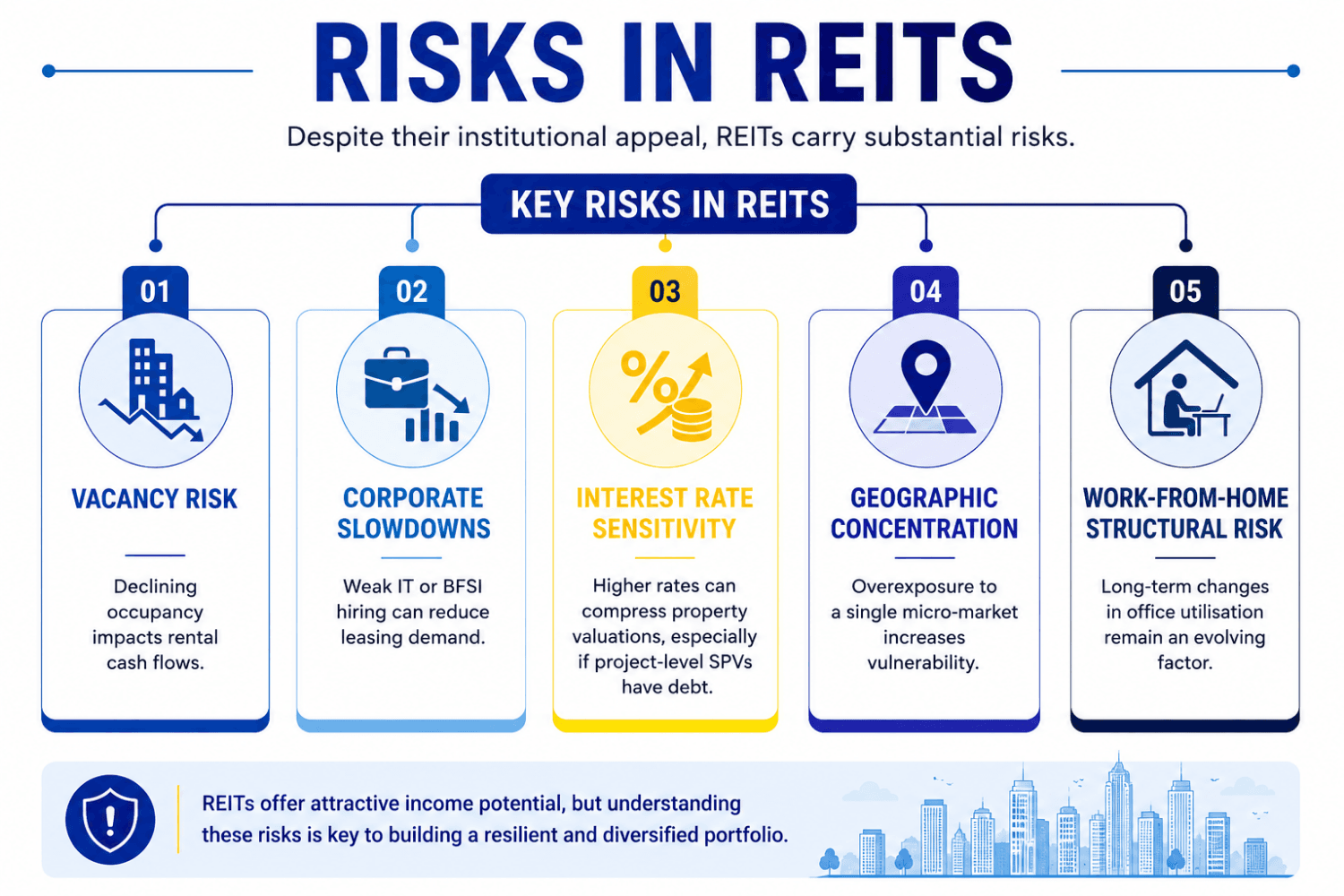
Risks in REITs
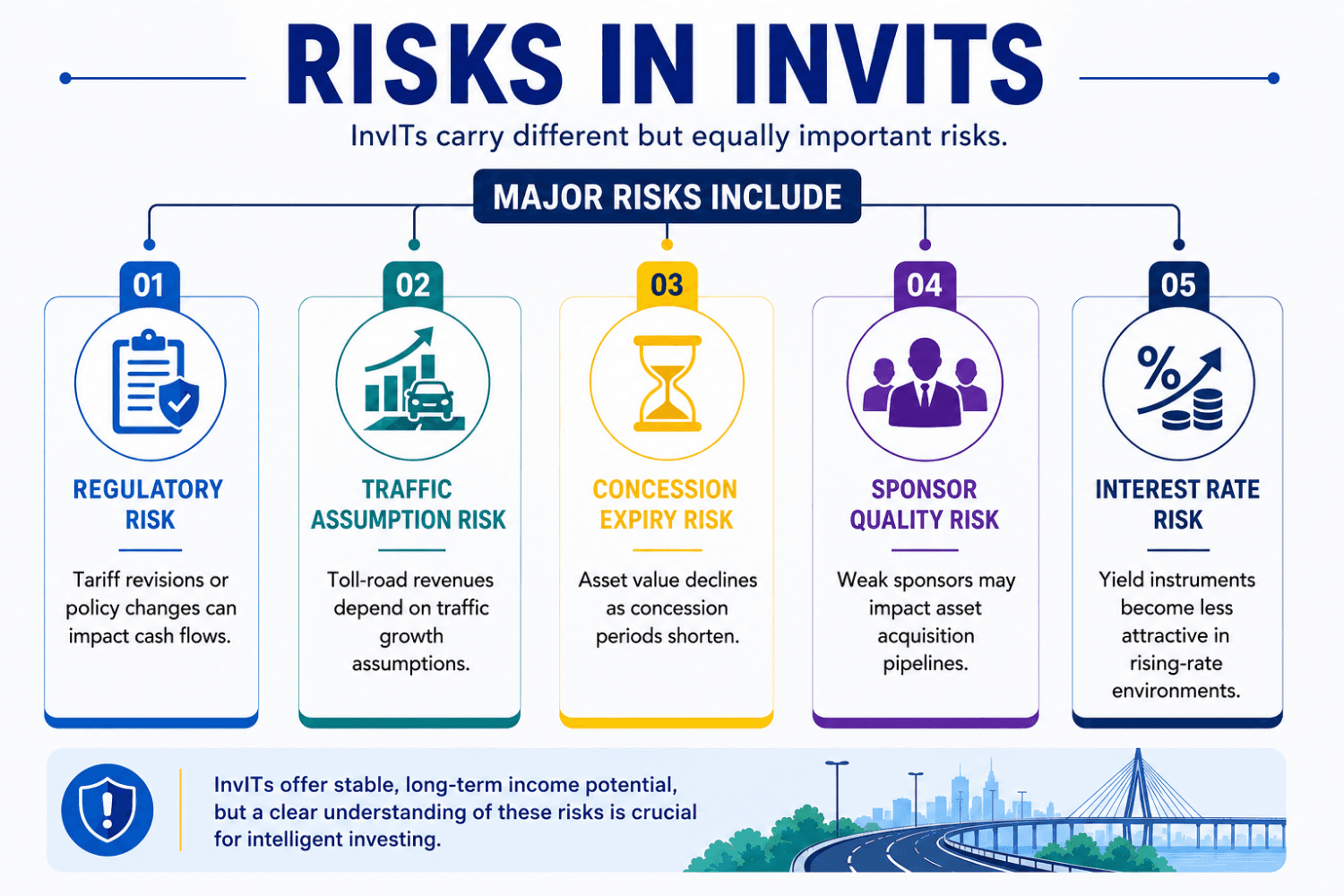
Risks in InvITs
REITs vs InvITs in a High-Net-Worth Portfolio
For sophisticated investors, the question is not REIT versus InvIT.
The real question is the allocation strategy.
When REITs Make More Sense
REITs are more suitable when an investor seeks:
Long-term wealth creation
Inflation protection
Urban growth exposure
Higher capital appreciation
Moderate recurring income
They work especially well for investors bullish on India’s:
GCC boom
Office leasing cycle
Commercial urbanisation
Premium real estate ecosystem
Moderate recurring income
When InvITs Make More Sense
InvITs are better suited for investors prioritising:
Predictable income
Lower volatility
Infrastructure participation
Defensive cash flows
Yield stability
They behave more like infrastructure-backed income securities.
To sum up,
The question isn't whether REITs are better than InvITs, or vice versa. A sophisticated portfolio often has room for both.
REITs provide exposure to India's commercial growth story. They allow investors to participate in rising rentals, improving occupancies, and the long-term appreciation of premium real estate assets.
InvITs provide exposure to India's infrastructure backbone. They offer access to the roads, power networks, telecom infrastructure, and essential assets that continue generating cash flows regardless of economic cycles.
In many ways, REITs are the growth engine of a real asset allocation, while InvITs are its stabilisers. One seeks to capture the upside of economic expansion; the other seeks to monetise the infrastructure that supports it.
As India's urbanisation, digitalisation, logistics transformation, and infrastructure spending continue to accelerate, both asset classes are likely to play an increasingly important role in investor portfolios. The key is not simply to chase the highest yield or the strongest recent returns, but to understand how each asset contributes to long-term wealth creation.
At AFINUE, we believe alternative investments should be evaluated not only for returns, but also for the role they play within a broader portfolio. Whether it is commercial real estate through REITs, infrastructure exposure through InvITs, private credit opportunities, or other alternative assets, informed allocation decisions remain one of the most powerful drivers of long-term investment outcomes.

Get Our Newsletter
You to create a robust alternate asset portfolio.FAQ’s
REITs invest in income-generating commercial real estate such as office parks, malls, and mixed-use developments. InvITs invest in infrastructure assets like highways, power transmission lines, telecom towers, pipelines, and renewable energy projects.
Neither is universally better. REITs generally offer higher capital appreciation potential through rental growth and property value appreciation, while InvITs typically provide more predictable income backed by long-term infrastructure concessions.
Both are regulated by SEBI and must distribute at least 90% of distributable cash flows. However, they carry different risks, including occupancy risk for REITs and regulatory or concession-related risks for InvITs.
Yes. Both distribute a significant portion of their distributable cash flows to investors, making them attractive for income-focused portfolios.
Taxation depends on the type of distribution received (interest, dividend, or repayment of capital) and whether units are sold within or after 12 months. Capital gains, interest income, and dividend distributions are taxed differently under Indian tax laws.
Yes. Many investors use REITs for exposure to commercial real estate growth and InvITs for relatively stable infrastructure-backed cash flows, allowing the two to complement each other within a diversified portfolio.
Related Insights

Golden Visas for Indians: Global Residency & Citizenship by Investment Guide
Explore Golden Visa and citizenship-by-investment programs available to Indians. Learn how global residency, investment migration, and mobility portfolios help diversify wealth, access global markets, and secure long-term opportunities.

REITs, InVITs, and Real Estate Tokenization: Transforming Property Investments
Explore how REITs, InVITs, and real estate tokenization are transforming property investments. Learn how these financial instruments provide liquidity, diversification, and access to high-value real estate for investors, making property investment easier.

Goa’s Real Estate Evolution: From Holiday Haven to Investment Powerhouse
What turned Goa from a tourist spot into India's fastest-growing property market? Read the blog to know how India's coastal paradise transformed into an investment hotspot.

Driving Tourism and Delivering High Yields: The Rise of Hotel Apartment Investments in Dubai
Read How Dubai hotel apartments evolved from pre-COVID growth to post-COVID resilience, now offering investors high yields and global credibility.

From Retreat to Returns: The Rise of Holiday Rentals in India
Holiday homes in India have evolved from family getaways to lucrative investment assets. Discover how shifting preferences, remote work, Airbnb, and fractional ownership are reshaping the holiday home to holiday rental market and how AFINUE is helping investors be a part of it.
Golden Visas for Indians: Global Residency & Citizenship by Investment Guide
Explore Golden Visa and citizenship-by-investment programs available to Indians. Learn how global residency, investment migration, and mobility portfolios help diversify wealth, access global markets, and secure long-term opportunities.
REITs, InVITs, and Real Estate Tokenization: Transforming Property Investments
Explore how REITs, InVITs, and real estate tokenization are transforming property investments. Learn how these financial instruments provide liquidity, diversification, and access to high-value real estate for investors, making property investment easier.
Goa’s Real Estate Evolution: From Holiday Haven to Investment Powerhouse
What turned Goa from a tourist spot into India's fastest-growing property market? Read the blog to know how India's coastal paradise transformed into an investment hotspot.
Driving Tourism and Delivering High Yields: The Rise of Hotel Apartment Investments in Dubai
Read How Dubai hotel apartments evolved from pre-COVID growth to post-COVID resilience, now offering investors high yields and global credibility.
From Retreat to Returns: The Rise of Holiday Rentals in India
Holiday homes in India have evolved from family getaways to lucrative investment assets. Discover how shifting preferences, remote work, Airbnb, and fractional ownership are reshaping the holiday home to holiday rental market and how AFINUE is helping investors be a part of it.