Being serious about ‘Horse’-ing around
12-07-2023
Being serious about ‘Horse’-ing around
Original Published on 12-07-2023
Updated on 17-03-2025
Horse ownership has traditionally been considered a sign of wealth, luxury, and opulence, equated with aristocracy and government. The idea that owning a horse is a luxury accessible only to the rich has been reinforced by images of affluent owners cheering their horses on, from extravagant private boxes in racecourses over generations. This view, however, does not accurately capture the reality of this industry.
Pedigree Horse ownership, particularly in the realm of racing, does entail significant expenses and hence the perception that it is only a passion indulgence. The initial cost of purchasing a pedigreed horse, which can become a racehorse, can be substantial ranging from a few thousand dollars to millions of dollars. Expenses for training, boarding, veterinary care, and race entry fees can quickly add up to average horse ownership cost. Moreover, the lifestyle associated with horse ownership, including attending races, maintaining stables, and participating in equestrian events, requires a significantly high level of financial commitment.
However, it is essential to recognize that horse ownership is not solely limited to the rich. There are individuals from diverse financial backgrounds who have found avenues to participate in the horse racing and equestrian world. While the upper echelons of horse ownership may indeed be dominated by the wealthy, there are opportunities for people with more modest means to enter the industry through various investment models and structures.
How can you own a horse with modest means?
If you're wondering how to become a horse owner or how to own a horse for the first time, you can buy into a structure that owns a horse through fractional ownership. In the market, these structures are commonly referred to as a “syndicate” or “horse syndicate.”
A horse syndicate is a type of shared ownership in which each member contributes financially to the purchase of one or more racehorses in exchange for legal or equitable rights to the animal and revenues earned through such animal(s). You will also need to split the expenses, such as those for veterinary care, travel, and training. Most of the time, you will be given a portion of the horses' lifetime earnings from prize money winnings, sale proceeds, and/or breeding rights. What does a first time horse owner need to know about these cost-sharing arrangements is an essential part of horse ownership 101.
There are several benefits of joining a syndicate when you are passionate about horses, horse racing or generally for any sport like equestrian or polo but, don’t want to make a very significant financial commitment and want to learn more about the industry before really biting deep into it. Here are a few factors that could help evaluate the syndicate structure better:
- Cost-sharing - Buying a racehorse outright may be a costly endeavour because it involves not only the original purchase price but also continuing costs for things like veterinary care, insurance, training, and race registration fees. These expenses are shared by all the members of a syndicate, as they come, making participation in horse racing more affordable.
- Learning - Being a part of a syndicate can give people who are new to the domain, invaluable insight into the business.
- Community and shared enjoyment - With a group of people who share your interests, you can experience the excitement of seeing your horse compete. Whether you win or lose, the shared experience may make it quite enjoyable.
- Access to Higher Quality Horses - A syndicate may be able to purchase horses of a higher caliber than an individual could afford outright thanks to its combined financial resources. This can raise the likelihood of owning a winning racehorse.
Assume you are looking to invest, where can you keep the horses?
There are many places in India where an Indian buyer can hope to stable their horses. For those new to this field and wondering how to become a horse owner or how to own a horse for the first time, understanding the basics of horse ownership 101 starts with choosing the right stable.
Private stables offer a variety of services, including boarding, training, and grooming. Many racecourses have stables that become available for rent and can be a good option for people who want to stable their horses on or near the course. One of the popular horse training facilities in India is Japalouppe Equestrian Centre. The facility is located in Talegaon, near Pune, Maharashtra. It offers a variety of training programs for horses of all levels, including racing, dressage, and show jumping.
Another well known training institute is Kings Equestrian located in Bangalore, which is known for its training programs, while also providing stabling and breeding facilities.
How Much Money Can You Make From Your Investments?
There are multiple avenues from which horse owners can generate revenue. Among these are “purse money”, “stud money” and “pinhooking”.
The majority of racehorse owners run their horses with the intention of making money. Every race has a purse, which is a predetermined sum of money that the track official determines based on the race's grade. Winners take home 60% of the prize money, followed by runners-up taking home 20%, third-place finishers 10%, fourth-place finishers 5%, fifth-place finishers 3%, and sixth-place finishers 2%.
If you owned the horse that won the race of a ₹1,00,000 prize pool, you would be rewarded with ₹60,000. Out of which 10% is generally given to the jockey and trainer each. That leaves you with a final winning of ₹48,000.[1]
There are roughly 400 race meetings held in India each year. The majority of these races are held in the states of Maharashtra, Karnataka, and Tamil Nadu. India boasts several prestigious horse races, including the renowned Indian Derby at Mumbai's Mahalaxmi Racecourse, the highly anticipated Bangalore Derby at the Bangalore Turf Club, and the historic Calcutta Derby held at the Royal Calcutta Turf Club along with races at Madras Race Club in Chennai.
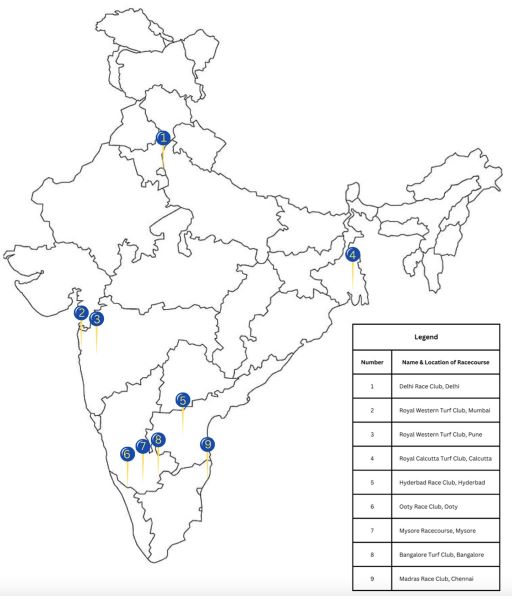
The size of the purse is determined by the type of horse racing, the venue, and the class of the event. In 2022, the famous Saudi Cup had a purse of $30.2 million (approximately ₹250 crores), whereas a race at a tiny, regional track might only pay out $2,000. The purse for the Indian Derby, the most prestigious racing event in the nation, was the highest in its history at ~₹2 crores with the winner’s purse at ₹1.2 crore. Almost half (5) of the 12 horses that participated in the derby were owned by syndicates.[2]
Once their racing days are finished, many Stallions enjoy a second career as stud animals. A stud animal is a male animal used for breeding. A stallion chosen as a stud in the context of horses is one that exhibits desirable traits including conformation, lineage, performance history, or breeding potential. In order to breed female horses (mares) and produce offspring with desirable qualities.
When a stud animal is used for breeding, it may be made accessible to mare owners through stud services. In exchange for access, mare owners must pay a stud fee or breeding charge. The stallion's reputation, achievements, and breeding potential can all affect the stud price and ultimate earnings for the horse owners.
A successful horse can earn a lot of money in racing, but its true earning potential may be as a stud. ‘Tapit’ is the highest-paid stud in the United States. He makes more than $35 million annually. He breeds 125 mares a year for a $300,000 stud fee. The typical stud cost for a talented stallion with a strong lineage is between $2,500 and $10,000 in the US horse racing market.[3]
Racehorse owners can also generate income through pinhooking, which involves purchasing a promising young racehorse with the intention of selling it at a profit later on. The concept revolves around acquiring a yearling or weanling, providing training to enhance its abilities, and subsequently selling it for a higher price. Pinhooking is a common practice in the world of young thoroughbreds, but it does come with inherent risks. Just like when someone first learns about horse racing bets, there is no guarantee of success regardless of favorable odds, and the same principle applies to pinhooking. If the horse fails to respond well to training or experiences injuries or illnesses, the investor stands to face significant financial losses. However, if the horse demonstrates potential and performs well at two years old, its value is likely to have significantly increased compared to its initial worth as a yearling.
If You Don’t Want To Invest Directly, What Are The Options, Besides Syndicates?
You can invest fractionally. There are multiple global fractional ownership platforms, the most popular ones being MyRacehorse, SportBLX and Commonwealth. The parent of MyRacehorse, namely Experiential Squared (E2), located in California, raised $7 million in capital recently. The platform works with an app, and with the help of the MyRacehorse app, prospective owners can research, evaluate, and buy a fractional part in the racehorse of their choice for a single one-time payment of as little as $100.[4]
Besides the option of fractional ownership, globally, there are investment funds or platforms that focus exclusively on the horse racing sector. These funds, which are also known as bloodstock investment funds, enable people to make investments in a variety of racehorses or breeding facilities. Professionals that manage these funds make investment choices on the investors' behalf with the goal of generating returns from racing and breeding activities. This approach not only helps to mitigate the overall average horse ownership cost but also offers a clear pathway for those asking what does a first-time horse owner needs to know before making a larger commitment.
Golden Farm Bloodstock offers investors the opportunity to invest in a portfolio of thoroughbred racehorses and breeding stock. The company's goal is to provide investors with the opportunity to participate in the potential financial gains from successful racehorses and breeding activities. Some other similar funds are Highclere Thoroughbred Racing, New York Thoroughbred Racing Fund and The Australian Thoroughbred Bloodstock Fund.
So, Is Buying A Horse Always Lucrative With High Returns?
A healthy racehorse can compete in up to 18 races year, but the average is more like seven with injuries, recovery times between races, and the availability of ideal races for the horse. Given that the typical owner in the US must spend ~$60,000 on expenses like day rates (ranging from $45 to $120 per horse per day), shoeing (between $100 and $400 per month), vet bills, insurance, licenses, and transportation, a horse, it seems, must finish first nearly all the time to make up for the owner's expenses, which is certainly unlikely.[5]
The industry is very competitive, and success in racing or breeding is not guaranteed. Although there is a chance to make money through selling horses, breeding fees, pinhooking or winning races, the results are unpredictable. The financial returns on your investment might be considerably impacted by factors like injuries, subpar performance, shifts or changes or cancellations of race fixtures, or other unfavorable racing circumstances, like weather at the time of an actual race.
It is true that the horse racing market size is growing.
The global horse racing market size was valued at USD 402.3 Billion in 2022 and is expected to reach USD 793.9 Billion by 2030, growing at a (compound annual growth rate) CAGR of 8.89% during the forecast period from 2023 to 2030.[6]
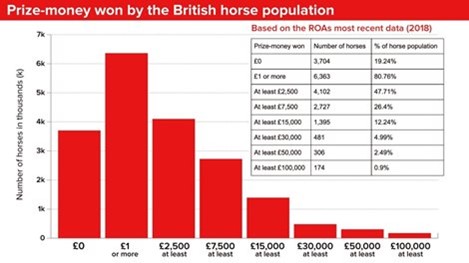
However, when considering horse ownership as an investment, it's important to note that the potential returns may differ from other traditional investment avenues. As highlighted in the 2021 British movie 'Dream Alliance,' joining a horse syndicate with a horse should not solely be driven by financial gain. While the chances of a horse winning a race are less than 1%, there are numerous other rewarding aspects to horse investment beyond purely annual returns.
Being serious about ‘Horse’-ing around
Bibliography
[1] https://sports.betmgm.com/en/blog/how-much-money-do-race-horse-owners-make/#:~:text=Every%20race%20has%20a%20purse,%2C%20and%202%25%20to%20sixth.
[2] https://www.thehindu.com/sport/races/19-horses-in-the-fray-for-the-blue-riband-indian-derby-to-be-run-on-feb-5/article66463728.ece
[3] https://sports.betmgm.com/en/blog/how-much-money-do-race-horse-owners-make/#:~:text=Every%20race%20has%20a%20purse,%2C%20and%202%25%20to%20sixth.
[4] https://www.thehindu.com/sport/races/19-horses-in-the-fray-for-the-blue-riband-indian-derby-to-be-run-on-feb-5/article66463728.ece
[5] https://horseracingsense.com/can-you-make-money-owning-a-racehorse
[6] https://www.finsmes.com/2023/06/myracehorse-raises-7m-in-funding
Related Blogs


10-01-2023
Can you invest in wine - What you need to know
Wine has been an investment asset class for as long as humanity has known to produce it. Unlike Whiskey, where you let it mature for equity gains, wine’s value grows even when stored in bottles, as the vintage and provenance matter in pricing
10-01-2023
Why is Whisky a Good Investment?
Whiskey is an untapped niche for serious investors and, in a period when redundant capital has chased up the prices of nearly everything else, it is worth a look, on those grounds alone.

12-07-2023
Being serious about ‘Horse’-ing around
Horse ownership is not limited to only the ultra-wealthy. Read more on fractional ownership avenues to participate in this equestrian world.

13-01-2025
Housing 31 Million Students, Will it be a Challenge?
Step into India's evolving world of purpose built student accommodation, where affordable student housing, modern campus living, and innovative investment opportunities redefine smart choices.
29-06-2023
550% returns in 13 years on a physical asset
Since 2010, gold has given a 200% return and silver 167%. Most people would be happy with those numbers. But imagine making over a 550% return on your investment, while being able to wear and flaunt it!